
You check a restaurant’s hygiene before eating there — but have you ever checked your dental clinic’s sterilization protocol? Dental instruments contact saliva, blood and tissue, which means an unsafe clinic can transmit infections that have nothing to do with teeth. Yet most patients in Delhi and Faridabad choose a dentist on price and distance alone, never asking the one question that actually protects them: “How do you sterilize your instruments?” As a clinic serving families in East of Kailash and Ashoka Enclave for years, we believe an informed patient is our best quality auditor. This guide explains exactly what a safe dental clinic does behind the scenes, the questions you have every right to ask, and the red flags that should make you pick up your bag and leave.
Table of Contents
- Why Dental Sterilization Matters More Than You Think
- Cleaning vs Disinfection vs Sterilization: Know the Difference
- What a Proper Sterilization Protocol Looks Like
- Single-Use Items: What Should Never Be Reused
- 7 Questions to Ask Before Choosing a Dental Clinic
- Red Flags That Should Make You Walk Out
- How Smile Dental Care Centre Handles Sterilization
- Safety for Children, Seniors & Medically Compromised Patients
- Frequently Asked Questions
- Our Clinic Locations
Why Dental Sterilization Matters More Than You Think
Dental procedures routinely create tiny amounts of bleeding — during extractions, implant placement, deep cleaning, even an injection. Instruments that touch one patient’s blood and are inadequately processed can carry hepatitis B, hepatitis C and other blood-borne pathogens to the next patient. Hepatitis B virus is especially hardy: it can survive on surfaces for days and requires true sterilization, not a quick wipe, to eliminate.
The good news is that dentistry done right is extremely safe. Organisations like the American Dental Association publish patient-facing guidance on infection control — their consumer site MouthHealthy.org is a useful reference — and the World Health Organization emphasises safe, quality oral health services as a core part of universal health coverage. The gap is not knowledge; it is whether an individual clinic actually follows the protocol every single day. That is where your questions come in.
Cleaning vs Disinfection vs Sterilization: Know the Difference
These three words are often used interchangeably by clinics — they should never be.
| Level | What It Does | Good Enough For |
|---|---|---|
| Cleaning | Removes visible debris with water, detergent and ultrasonic baths | First step only — never sufficient alone |
| Disinfection | Chemical wipes/solutions kill most (not all) microorganisms | Surfaces: chairs, light handles, trays, countertops |
| Sterilization | Autoclave steam under pressure kills all microorganisms including spores | Every instrument that enters the mouth |
The rule is simple: surfaces get disinfected, instruments get sterilized. A clinic that dips instruments in a jar of antiseptic solution between patients is disinfecting at best — and that is not acceptable for items that touch tissue.
What a Proper Sterilization Protocol Looks Like
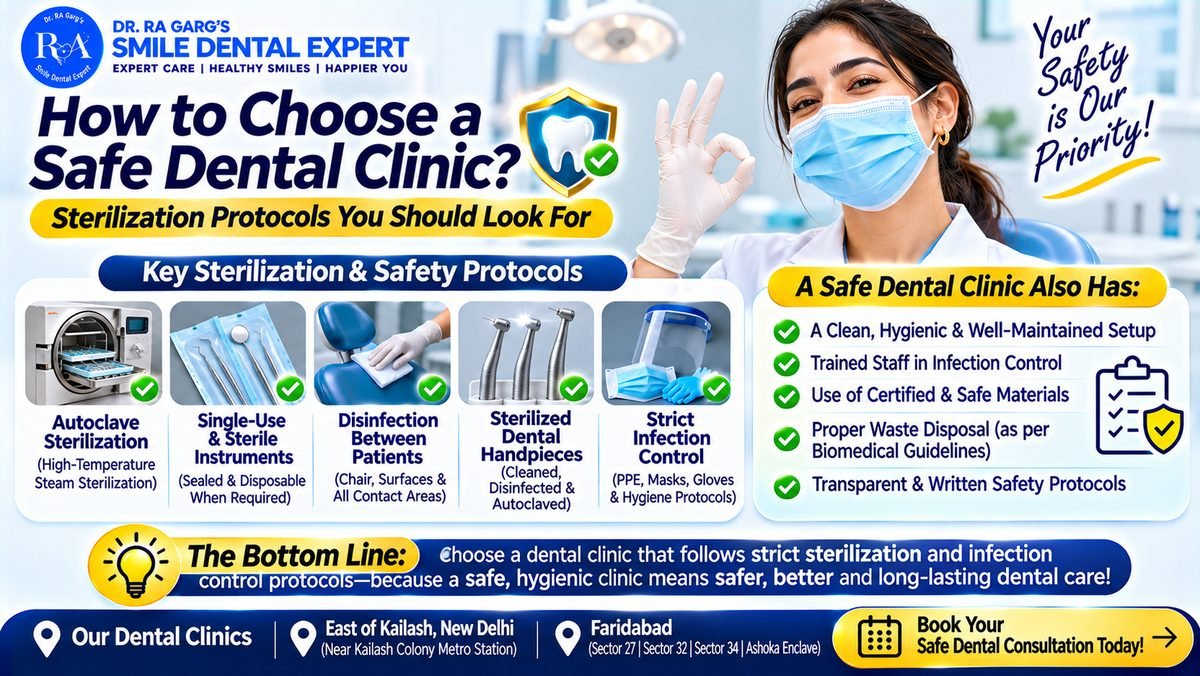
In a well-run clinic, every instrument travels through a defined cycle after every single use:
Step 1: Pre-cleaning and ultrasonic scrubbing
Used instruments go into an enzymatic solution, then an ultrasonic cleaner that vibrates away debris from grooves and hinges that brushing cannot reach. Staff handle them with heavy-duty gloves — safety applies to the team too.
Step 2: Inspection, drying and pouching
Each instrument is inspected, dried and sealed in a sterilization pouch. The pouch has a chemical indicator strip that changes colour only when the correct temperature and pressure have been reached.
Step 3: Autoclaving
Pouches go into an autoclave — a pressurised steam chamber running at roughly 121–134°C. Modern Class B autoclaves use vacuum cycles so steam penetrates hollow instruments, like the handpieces (drills) that are hardest to sterilize. Handpieces deserve special mention: they must be autoclaved between patients, not merely wiped, because they can suck back aerosols internally during use.
Step 4: Sealed storage and chairside opening
Sterile pouches stay sealed until the moment of use. In a transparent clinic, the pouch is opened in front of you, at the chair — that tearing sound is the sound of a safe appointment.
Step 5: Monitoring the autoclave itself
Indicator strips verify each load, and periodic biological (spore) testing verifies the machine truly kills the most resistant organisms. Clinics should also flush dental unit waterlines and disinfect suction lines daily.
Single-Use Items: What Should Never Be Reused
Some items cannot be reliably sterilized and must be discarded after one patient:
- Needles and anaesthetic cartridges — always, without exception
- Saliva ejectors and suction tips
- Gloves and masks (changed between every patient)
- Scalpel blades and matrix bands
- Prophy cups and certain polishing attachments
Disposables exist because their shapes trap contamination. A clinic that rinses and reuses saliva ejectors to save a few rupees is telling you everything you need to know about its other shortcuts. Sharps must also leave the clinic safely — look for puncture-proof sharps containers and tie-ups for biomedical waste disposal, which is a legal requirement for Indian clinics.
7 Questions to Ask Before Choosing a Dental Clinic
A trusted dentist will welcome these questions. Hesitation or vagueness is itself an answer.
- “Do you use an autoclave, and may I see it?” Transparent clinics show you their sterilization room with pride.
- “Are instruments pouched with indicator strips?” Look for colour-changed indicators on the pouch opened at your chair.
- “Are handpieces autoclaved between patients?” The single most revealing question in dentistry.
- “Which items are single-use here?” You should hear needles, suction tips, gloves at minimum.
- “How do you dispose of biomedical waste?” The answer should mention an authorised disposal service.
- “Do you take a medical history before treatment?” Safe clinics screen every patient — infection control works both ways.
- “Who performs surgical procedures?” For extractions and implants, a qualified surgeon with hospital-grade asepsis matters; meet our team on the about page.
Red Flags That Should Make You Walk Out
- Instruments lying loose in open trays or jars of liquid between patients
- The dentist or assistant not changing gloves in front of you
- No visible autoclave, or a pressure-cooker-style device being passed off as one
- Reused saliva ejectors or needles being recapped carelessly
- A “too cheap to be true” price for surgical work — asepsis has a cost, and clinics that slash it cut invisible corners first
- No medical history asked, no records kept
Price-shopping is natural, but remember: an infection acquired from a ₹500-cheaper filling can cost months of health. This is especially true for surgical care such as wisdom tooth removal and implant placement, where instruments enter bone.
How Smile Dental Care Centre Handles Sterilization
At both our East of Kailash (Kailash Hills) and Ashoka Enclave, Faridabad clinics, infection control is a daily discipline, not a marketing line:
- Autoclave-based sterilization for every instrument set, with pouching and chemical indicators on each pouch
- Handpieces autoclaved between patients, with multiple sets in rotation so there is never pressure to skip a cycle
- Strict single-use policy for needles, suction tips, gloves, masks and scalpel blades
- Surface disinfection of the operatory — chair, light, spittoon, tray — between every appointment
- Authorised biomedical waste segregation and disposal at both locations
- Surgeon-led surgical asepsis: implants and surgical extractions are performed by Dr. Ashish Garg, oral & maxillofacial surgeon, using full barrier protocols
Patients beginning longer treatments — say a painless root canal treatment or dental implants in East of Kailash — are welcome to tour the sterilization area before starting. You can also preview our equipment on the facilities page.
Safety for Children, Seniors & Medically Compromised Patients
Infection control standards are universal, but some patients deserve extra vigilance — and should factor it into choosing a clinic.
Children
Kids wiggle, touch instrument trays and put fingers in their mouths mid-procedure. A child-safe clinic keeps sealed pouches out of reach, opens instruments only when the child is settled, and uses fresh disposables for every attempt — even if a restless toddler needs two visits to finish one filling.
Senior citizens and diabetic patients
Healing is slower after 60, and uncontrolled diabetes multiplies infection risk after extractions or deep cleaning. For these patients we review medical history in detail, coordinate with physicians where needed, and schedule surgical work in morning slots when the operatory is freshly prepared and the patient is freshest too.
Patients on immunosuppressants or undergoing chemotherapy
Anyone with a weakened immune system should inform the clinic in advance. Appointment sequencing (first slot of the day), extended barrier protocols and pre-procedure rinses meaningfully reduce exposure. A clinic that shrugs at this disclosure is the wrong clinic.
If someone in your family falls into these groups, ask the clinic how they adapt — the quality of that answer tells you how seriously they take the routine cases too.
Frequently Asked Questions
What is the correct sterilization protocol for a dental clinic?
Ultrasonic cleaning, drying and pouching with indicator strips, autoclaving under pressurised steam, sealed storage, and opening pouches only at the chairside — plus strict single-use disposables and authorised biomedical waste disposal.
How can I tell if dental instruments are properly sterilized?
Look for sealed pouches opened in front of you with a colour-changed indicator strip. Loose instruments on an open tray, or instruments stored in liquid, are not sterile.
Can I ask my dentist to show me their autoclave?
Yes — and you should. Reputable clinics in Delhi and Faridabad will happily show you the sterilization room; discomfort with the question is a warning sign.
Are dental drills (handpieces) sterilized between patients?
They must be. Handpieces can draw contaminated aerosols into their internal tubing, so wiping the outside is not enough — they require autoclaving between every patient.
Is it safe to get dental treatment during flu season or after an illness?
Yes, at a clinic following universal precautions — every patient is treated as potentially infectious, so protocols do not change based on who is in the chair. Do tell your dentist about recent illnesses and medications during history-taking.
Does better sterilization make treatment more expensive?
Marginally — pouches, indicators, disposables and autoclave maintenance have real costs. It is the best money you will never see itemised: the cost of nothing going wrong.
Our Clinic Locations
Smile Dental Care Centre — East of Kailash, New Delhi
C 8, Captain Gaur Marg, C Block Kailash Hills, East of Kailash, New Delhi 110065
Phone: 011 35966954 / +91 93183 39020
View on Google Maps
Smile Dental Care Centre — Faridabad
210, G Floor, Ashoka Enclave Main, Sector 34, Opp. Devsthal Mandir, Near Sarai Metro Station, Faridabad 121001
Phone: 0129 412 8720 / +91 99990 27270
View on Google Maps
Want to see our sterilization setup before booking? Ask us on WhatsApp — we will happily arrange a walk-through.
Choose a Clinic That Welcomes Your Questions
The safest dental clinic is the one that treats your scrutiny as a compliment. Bring this article’s seven questions to your next consultation — including ours. Call +91 93183 39020, message us on WhatsApp, or book an appointment online at East of Kailash or Faridabad, and judge our answers for yourself.