

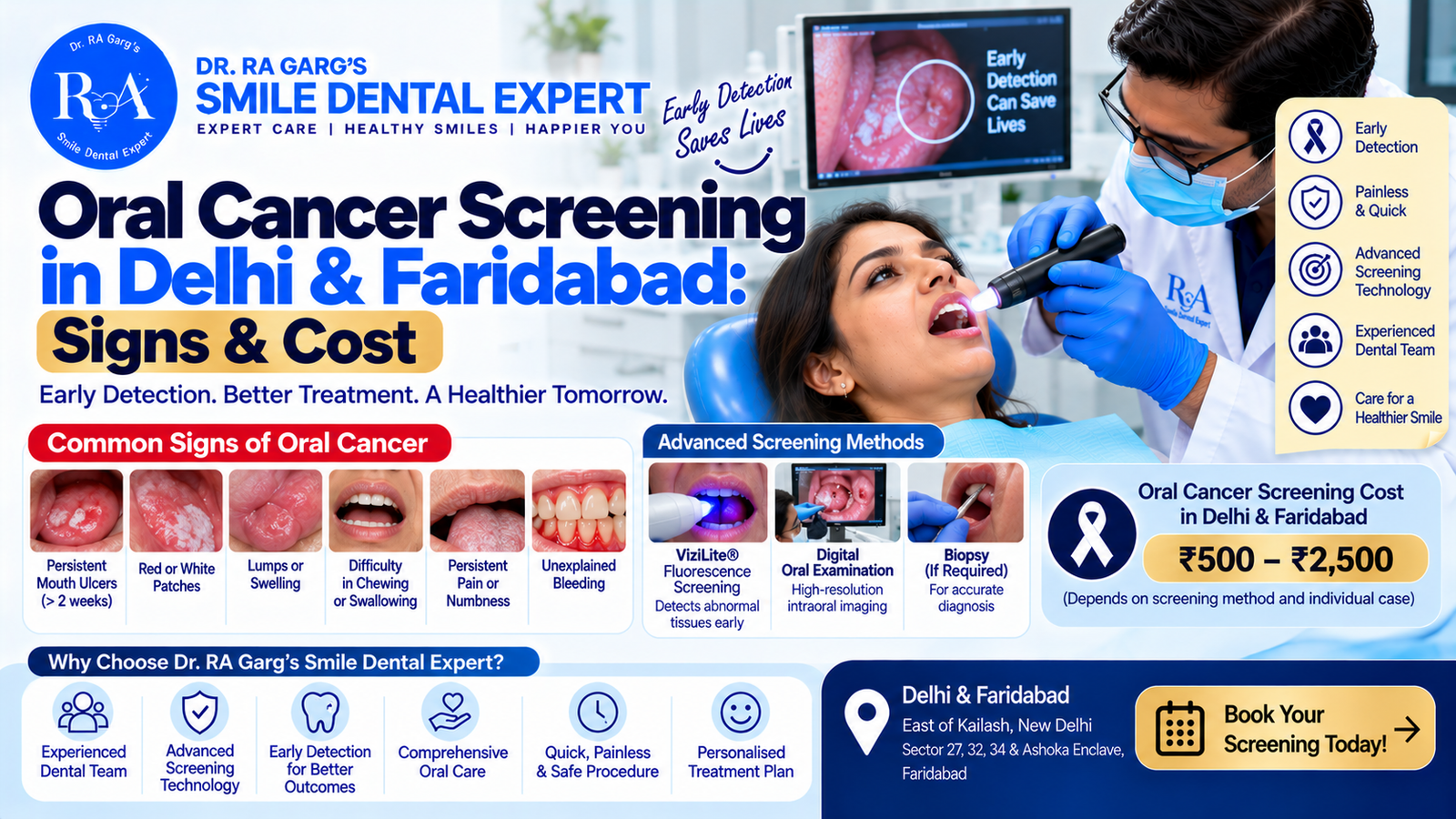
Oral cancer screening is a quick, painless examination that can quite literally save your life. India records among the highest numbers of oral cancer cases in the world, largely driven by tobacco chewing, gutkha, paan masala and smoking — yet most cases are detected late, when treatment becomes harder and costlier. At Smile Dental Care Centre, with clinics in East of Kailash (New Delhi) and Ashoka Enclave, Faridabad, our oral and maxillofacial surgeon Dr. Ashish Garg performs structured oral cancer screening during routine check-ups, so suspicious changes are caught early. This guide explains what oral cancer screening involves, the warning signs you should never ignore, who needs screening most, and what it costs in Delhi NCR in 2026.
Table of Contents
- What Is an Oral Cancer Screening?
- Why Oral Cancer Screening Matters So Much in India
- Early Warning Signs of Oral Cancer
- Who Needs Oral Cancer Screening the Most?
- What Happens During a Screening Appointment
- Oral Cancer Screening Cost in Delhi & Faridabad (2026)
- Pre-Cancerous Conditions: Leukoplakia, Erythroplakia & OSMF
- How to Lower Your Oral Cancer Risk
- Frequently Asked Questions
- Our Clinic Locations
What Is an Oral Cancer Screening?
An oral cancer screening is a systematic visual and physical examination of your mouth, lips, tongue, cheeks, palate, floor of the mouth and throat, performed by a dentist or oral surgeon to detect cancerous or pre-cancerous changes before they cause obvious symptoms. It takes barely five to ten minutes and requires no injections, cutting or discomfort.
The purpose is early detection. When oral cancer is found at an early, localised stage, survival rates improve dramatically and treatment is far less invasive. According to the World Health Organization’s oral health fact sheet, oral diseases — including oral cancers — affect close to 3.5 billion people globally, and the burden falls disproportionately on countries like India where tobacco use remains widespread.
Screening vs. Diagnosis
It is important to understand that screening does not confirm cancer. It identifies suspicious areas — a non-healing ulcer, a white or red patch, a lump — that then need further evaluation, usually a biopsy. Most abnormalities found during screening turn out to be harmless, but the only way to know for certain is professional assessment.
Why Oral Cancer Screening Matters So Much in India
Oral cancer is among the most common cancers in Indian men and a significant cause of cancer deaths nationwide. The reasons are well documented: chewing tobacco, gutkha, khaini, zarda, betel quid with areca nut, bidi and cigarette smoking, and heavy alcohol use. Many patients in Delhi NCR use more than one of these products daily, multiplying their risk.
The tragedy is that the mouth is one of the easiest parts of the body to examine. Unlike cancers hidden deep inside the body, oral cancers and pre-cancers are visible — if someone looks. A simple screening at your dental clinic can detect changes months or years before they would otherwise be noticed.
The Role of Your Dentist
Dentists are the first line of defence against oral cancer because they look inside mouths all day. At our clinics, every comprehensive examination includes a soft-tissue check. Dr. Ashish Garg, our oral and maxillofacial surgeon in Faridabad, has specialised surgical training in diagnosing and managing lesions of the mouth, jaws and face, which means suspicious findings are evaluated by exactly the right specialist without needless referrals.
Early Warning Signs of Oral Cancer
See a dentist promptly — do not wait for your next routine visit — if you notice any of the following lasting more than two weeks:
- A mouth ulcer or sore that does not heal
- A white patch (leukoplakia) or red patch (erythroplakia) on the gums, tongue, cheek or palate
- A lump, thickening or rough crusted area inside the mouth or on the lip
- Unexplained bleeding or numbness in the mouth
- Difficulty or pain while chewing, swallowing or moving the tongue
- Progressive difficulty opening the mouth (a hallmark of oral submucous fibrosis)
- A persistent sore throat, hoarseness or feeling that something is caught in the throat
- A swelling or lump in the neck
- Loose teeth with no obvious gum disease, or a denture that suddenly stops fitting
Why “Wait and Watch” Is Dangerous
Most people assume a mouth ulcer is caused by a sharp tooth, spicy food or stress — and usually they are right. But an ulcer that has not healed in fourteen days deserves professional examination. Early oral cancers are frequently painless, which is precisely why they get ignored until they grow.
Who Needs Oral Cancer Screening the Most?
Everyone benefits from an annual soft-tissue examination, but screening is especially critical if any of the following applies to you:
- Tobacco users: smokers and users of gutkha, khaini, paan masala, zarda or snuff — in any quantity, past or present
- Regular alcohol consumers: alcohol multiplies tobacco’s cancer-causing effect
- Betel quid / areca nut (supari) chewers: areca nut is independently carcinogenic even without tobacco
- People over 40: risk rises with age, though we increasingly see younger patients
- Those with previous oral lesions: a history of leukoplakia, lichen planus or submucous fibrosis requires scheduled follow-up
- People with sharp teeth or ill-fitting dentures: chronic friction and trauma can contribute to tissue changes
- HPV exposure: human papillomavirus is a growing cause of mouth and throat cancers worldwide
If you fall into a high-risk group, we recommend screening every six months — conveniently done alongside your regular dental check-up at our East of Kailash or Faridabad clinic.
What Happens During a Screening Appointment
Step 1: History and Risk Assessment
The dentist asks about tobacco, alcohol and supari habits, family history, previous lesions and any symptoms you have noticed. Honest answers matter — there is no judgement, only better care.
Step 2: Extra-Oral Examination
We examine your face, lips and jawline and gently palpate the lymph nodes of your neck for any enlargement or firmness.
Step 3: Intra-Oral Examination
Using a mouth mirror and good lighting, the surgeon systematically inspects every surface: lips, inner cheeks, gums, all surfaces of the tongue, floor of the mouth, hard and soft palate and the back of the throat. The tongue and floor of mouth are palpated because some lesions are felt before they are seen.
Step 4: Documentation and Next Steps
Any suspicious area is measured, photographed and documented. Depending on findings, the next step may be removing a source of irritation and reviewing in two weeks, a biopsy performed under local anaesthesia, or referral for further imaging. Our clinics are equipped with digital X-rays and modern diagnostic tools — you can read more about our clinic facilities.
Oral Cancer Screening Cost in Delhi & Faridabad (2026)
Oral cancer screening is one of the least expensive investigations in all of healthcare — and often free as part of a routine dental consultation. Typical 2026 costs in Delhi NCR:
| Service | Approximate Cost (₹) |
|---|---|
| Dental consultation with soft-tissue screening | ₹300 – ₹700 |
| Detailed oral cancer screening with documentation | ₹500 – ₹1,500 |
| Digital X-ray / OPG (if indicated) | ₹300 – ₹1,000 |
| Incisional biopsy with histopathology report | ₹2,500 – ₹6,000 |
| Excisional biopsy of small lesion | ₹4,000 – ₹10,000 |
Compare that with the cost — financial, physical and emotional — of treating advanced oral cancer, which can run into many lakhs of rupees. Early detection is not just safer; it is vastly more economical.
Pre-Cancerous Conditions: Leukoplakia, Erythroplakia & OSMF
Leukoplakia
A white patch that cannot be wiped off and cannot be attributed to any other disease. Most leukoplakias are benign, but a percentage transform into cancer over time, so they must be biopsied and monitored.
Erythroplakia
A velvety red patch — less common than leukoplakia but far more dangerous, with a much higher rate of malignant change. Any red patch in the mouth warrants urgent evaluation.
Oral Submucous Fibrosis (OSMF)
Caused primarily by areca nut (supari) chewing, OSMF stiffens the cheek tissues, causes burning with spicy food and progressively restricts mouth opening. It is widespread in North India and carries significant cancer risk. Stopping supari immediately, along with medical management, can halt progression.
Chronic Trauma and Sharp Teeth
A broken tooth edge or ill-fitting denture rubbing the same spot for years creates chronic ulcers that need attention. Smoothing the tooth, placing a crown or correcting the denture removes the irritant — our team handles everything from tooth-coloured fillings to crowns and bridges in Faridabad so no source of friction is left behind.
How to Lower Your Oral Cancer Risk
- Quit all tobacco — smoked and smokeless. Risk begins falling within months of quitting and keeps falling for years.
- Stop areca nut / supari, including “tobacco-free” paan masala — areca nut itself is a Group 1 carcinogen.
- Limit alcohol, and never combine heavy drinking with tobacco.
- Eat a diet rich in fruits and vegetables — antioxidants support healthy oral tissue.
- Protect your lips from the sun with an SPF lip balm if you work outdoors.
- Maintain oral hygiene and regular dental visits — twice-yearly check-ups double as screening opportunities.
- Self-examine monthly: in good light, look at your tongue (top, sides, underneath), cheeks, gums and palate; feel for lumps. Report anything new that persists beyond two weeks.
The National Institute of Dental and Craniofacial Research (NIDCR) provides excellent patient resources on oral cancer detection and self-examination that complement professional screening.
Frequently Asked Questions
Is oral cancer screening painful?
Not at all. It is a visual and gentle physical examination — no needles, no instruments beyond a mouth mirror and gauze. Even a biopsy, if needed later, is done under local anaesthesia and feels similar to a small filling appointment.
How often should I get screened for oral cancer?
Low-risk adults should be screened once a year, usually during a routine dental check-up. Tobacco or supari users, heavy drinkers and anyone with a previous oral lesion should be examined every six months.
Can a mouth ulcer that heals and comes back be cancer?
Recurrent ulcers that fully heal between episodes are usually aphthous ulcers (canker sores) and are not cancerous. The worrying sign is a single ulcer that never heals for more than two weeks. When in doubt, get it checked — it takes ten minutes.
Does oral cancer only affect tobacco users?
No. Tobacco and areca nut are the biggest causes in India, but oral cancer also occurs in non-users due to HPV infection, chronic trauma, heavy alcohol use and genetic factors. That is why routine screening is recommended for everyone.
What happens if my dentist finds a suspicious patch?
First, any obvious irritant (sharp tooth, denture edge) is corrected and the area reviewed after two weeks. If the lesion persists, a small biopsy is taken and sent for histopathology. Dr. Ashish Garg performs biopsies in-clinic under local anaesthesia, and results typically arrive within a week.
Is oral cancer curable if detected early?
Early-stage oral cancers have excellent outcomes, with five-year survival far higher than late-stage disease. Many early lesions are treated with minor surgery alone. This is the entire argument for screening: the earlier it is found, the simpler the cure.
Our Clinic Locations
Smile Dental Care Centre — East of Kailash, New Delhi
C 8, Captain Gaur Marg, C Block Kailash Hills, East of Kailash, New Delhi 110065
Phone: 011 35966954 / +91 9318339020
View on Google Maps — East of Kailash clinic
Smile Dental Care Centre — Ashoka Enclave, Faridabad
210, G Floor, Ashoka Enclave Main, Sector 34, Opp. Devsthal Mandir, Near Sarai Metro Station, Faridabad 121001
Phone: 0129 412 8720 / +91 99990 27270
View on Google Maps — Faridabad clinic
Questions about a mouth ulcer or patch? Message us directly on WhatsApp at +91 93183 39020 and our team will guide you on the next step.
Book Your Oral Cancer Screening Today
A ten-minute examination today can prevent a life-changing diagnosis tomorrow. If you use tobacco or supari, have noticed a patch, lump or non-healing ulcer, or simply haven’t had your mouth examined in over a year, book a screening with Dr. Ashish Garg at Smile Dental Care Centre. Call +91 93183 39020, message us on WhatsApp, or book your appointment online at our East of Kailash or Faridabad clinic.
