

Invisalign vs Braces in Delhi: Cost, Duration & Results Compared (2026)
Choosing between Invisalign vs braces is one of the most common dilemmas patients face when starting orthodontic treatment in Delhi. Both options can straighten your teeth, fix bite issues, and give you a confident smile — but they differ significantly in cost, comfort, visibility, and treatment duration. With so many clinics offering varying prices and promises, it is essential to have accurate, expert-backed information before making your decision.
I am Dr. Rekha Garg (BDS, MDS Orthodontics, M.Orth RCS Edinburgh), a specialist orthodontist practising in South Delhi and Faridabad with over 15 years of clinical experience. I have treated thousands of patients with both braces and Invisalign, and in this detailed guide, I will walk you through everything you need to know about invisalign vs braces — from cost breakdowns and treatment timelines to real pros and cons — so you can make the right choice for your smile.
Whether you are a working professional looking for a discreet option, a parent exploring treatment for your teenager, or someone simply wanting the most affordable path to straight teeth, this comparison will help you decide. Let us dive in.
What Are Braces and Invisalign?
Traditional Braces
Braces are the most time-tested orthodontic treatment available. They consist of small metal or ceramic brackets bonded to the front surface of each tooth, connected by an archwire. The orthodontist periodically tightens or changes the wire, applying controlled pressure that gradually moves teeth into their ideal positions. Braces come in several varieties:
- Metal braces — the classic stainless-steel brackets, now smaller and more comfortable than ever before
- Ceramic braces — tooth-coloured brackets that blend with your natural enamel for a less noticeable appearance
- Lingual braces — brackets placed on the inner (tongue-side) surface of teeth, making them completely invisible from the outside
- Self-ligating braces — use a specialised clip mechanism instead of elastic ties, often resulting in fewer adjustment visits and reduced friction
Braces are highly effective for all types of orthodontic problems, from simple crowding to complex bite corrections including overbites, underbites, crossbites, and open bites.
Invisalign (Clear Aligners)
Invisalign is a modern orthodontic system that uses a series of custom-made, transparent plastic trays (called aligners) to move teeth gradually. Each set of aligners is worn for one to two weeks before switching to the next set in the sequence. The aligners are removable, meaning you can take them out to eat, brush, and floss.
Invisalign uses advanced 3D imaging and computer-aided design to map out the entire treatment plan from start to finish. Patients can even preview their expected results before beginning treatment. While Invisalign was once limited to mild cases, modern advances now allow it to treat moderate and even some complex orthodontic issues.
When comparing invisalign vs braces, the most immediate difference patients notice is aesthetics — Invisalign is nearly invisible, while braces are more noticeable. However, the differences go much deeper than appearance alone.
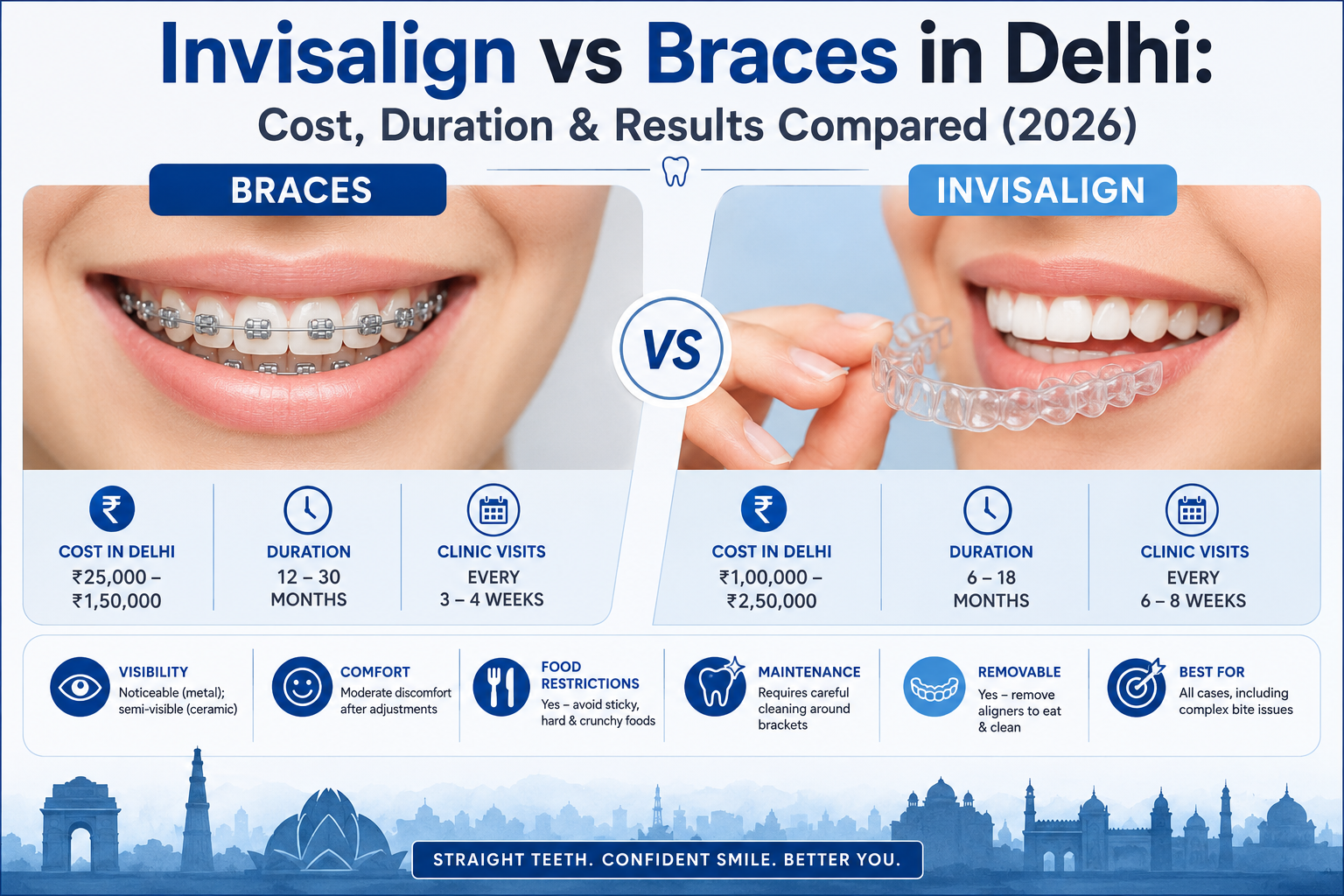
Invisalign vs Braces — Complete Comparison Table
The table below provides a comprehensive side-by-side comparison to help you understand every key difference between invisalign vs braces at a glance.
| Feature | Traditional Braces | Invisalign (Clear Aligners) |
|---|---|---|
| Cost in Delhi (2026) | ₹25,000 – ₹1,50,000 | ₹1,00,000 – ₹2,50,000 |
| Treatment Duration | 12 – 30 months | 6 – 18 months |
| Visibility | Noticeable (metal); semi-visible (ceramic) | Nearly invisible |
| Pain & Discomfort | Moderate, especially after adjustments | Mild pressure when switching trays |
| Maintenance | Requires careful brushing around brackets; flossing with threaders | Remove aligners to brush and floss normally |
| Clinic Visits | Every 3 – 4 weeks | Every 6 – 8 weeks |
| Food Restrictions | Yes — avoid sticky, hard, and crunchy foods | None — remove aligners before eating |
| Age Suitability | All ages (children, teens, adults) | Teens and adults (requires compliance) |
| Best For | Complex cases, severe crowding, major bite correction | Mild to moderate crowding, spacing, discreet treatment |
This comparison shows that the choice between invisalign vs braces depends on your specific dental condition, lifestyle preferences, and budget. Neither option is universally better — the right treatment is the one that fits your individual needs.
Cost Comparison in Delhi 2026
Cost is often the deciding factor for patients weighing invisalign vs braces. Delhi offers a wide range of pricing depending on the type of appliance, the complexity of your case, the orthodontist’s expertise, and the clinic’s location. Below is a detailed cost table for 2026.
| Treatment Type | Estimated Cost in Delhi (2026) | Key Notes |
|---|---|---|
| Metal Braces | ₹25,000 – ₹50,000 | Most affordable option; highly effective for all case types |
| Ceramic Braces | ₹40,000 – ₹70,000 | Tooth-coloured; less visible than metal; slightly more fragile |
| Lingual Braces | ₹80,000 – ₹1,50,000 | Placed behind teeth; completely hidden; higher skill required |
| Self-Ligating Braces | ₹50,000 – ₹80,000 | Fewer visits needed; reduced friction; faster in some cases |
| Invisalign | ₹1,00,000 – ₹2,50,000 | Premium brand; advanced 3D planning; near-invisible |
| Other Clear Aligners | ₹60,000 – ₹1,50,000 | Various Indian and international brands; quality varies |
As you can see, braces are significantly more affordable than Invisalign in most cases. Metal braces remain the most budget-friendly choice at ₹25,000 to ₹50,000, while Invisalign typically starts at ₹1,00,000 and can go up to ₹2,50,000 for full-arch treatment of complex cases.
However, cost should not be the only factor. The value of a treatment depends on the expertise of your orthodontist, the quality of materials used, and how well the treatment plan is customised to your specific needs. A cheaper treatment done poorly can end up costing more in the long run if retreatment is needed.
At Smile Dental Care Centre, we provide transparent pricing with no hidden charges. Our orthodontic treatment cost page has detailed pricing information, and we offer flexible EMI options to make quality treatment accessible to everyone.
Who Should Choose Braces?
While the invisalign vs braces debate often leans towards aesthetics, there are many clinical and practical scenarios where braces are clearly the better choice. Here are five situations where I recommend braces to my patients:
1. You Have a Complex Orthodontic Problem
If you have severe crowding, significant bite issues (deep overbite, underbite, crossbite, or open bite), or teeth that need to be rotated substantially, braces offer superior control. The brackets and wires allow the orthodontist to apply precise forces in multiple directions simultaneously, which is something aligners cannot always replicate. For complex cases, braces treatment remains the gold standard.
2. You Are on a Tight Budget
Metal braces starting at ₹25,000 are roughly four to five times less expensive than Invisalign. If cost is a primary concern but you still want excellent results from a qualified orthodontist, braces deliver outstanding value. Our clinics offer braces treatment in East of Kailash and braces treatment in Faridabad at competitive prices.
3. You Are a Child or Young Teenager
Braces work exceptionally well for younger patients who may not have the discipline to wear removable aligners for the required 20-22 hours per day. Since braces are fixed to the teeth, there is no risk of the patient forgetting to wear them or losing them. Orthodontic treatment for children and teens often involves guiding jaw growth, which braces handle effectively.
4. You Need Extractions or Jaw Surgery
Certain cases require tooth extractions to create space, followed by closing those gaps precisely. Braces excel at controlled space closure with techniques like power chains and sliding mechanics. Similarly, if your treatment plan involves surgical orthodontics (corrective jaw surgery), braces are almost always the required appliance before and after the procedure.
5. You Want the Fastest Result for Severe Misalignment
For significantly misaligned teeth, braces often work faster because they exert continuous force 24 hours a day. Unlike aligners, which are removed for meals and cleaning, braces are always working. In cases of severe crowding or major bite correction, braces can sometimes deliver results in a shorter overall timeframe.
Who Should Choose Invisalign?
On the other side of the invisalign vs braces comparison, there are equally compelling reasons to choose clear aligners. Here are five scenarios where Invisalign is the better fit:
1. You Are a Working Professional Who Values Discretion
If you attend meetings, give presentations, or work in a client-facing role, the near-invisibility of Invisalign is a major advantage. Nobody needs to know you are undergoing orthodontic treatment unless you choose to tell them. This discreet approach is one of the top reasons adults prefer Invisalign over traditional braces.
2. You Have Mild to Moderate Crowding or Spacing
Invisalign works exceptionally well for cases involving mild to moderate crowding, gaps between teeth, and minor bite adjustments. If your orthodontist confirms that your case complexity falls within the scope of clear aligner therapy, Invisalign can deliver beautiful results with greater comfort. Explore our invisible braces options in East of Kailash or invisible braces in Faridabad.
3. You Want Fewer Clinic Visits
Invisalign typically requires visits only every 6 to 8 weeks, compared to every 3 to 4 weeks for braces. If you have a busy schedule or need to travel frequently, fewer appointments can be a significant convenience. Some monitoring can even be done remotely with progress photos in certain cases.
4. You Do Not Want Food Restrictions
With braces, you must avoid hard, sticky, and crunchy foods that can damage brackets or get stuck in wires. Invisalign has zero food restrictions — simply remove your aligners before eating, enjoy whatever you like, brush your teeth, and put the aligners back in. For food enthusiasts, this is often a deciding factor in the invisalign vs braces choice.
5. You Prioritise Comfort and Oral Hygiene
Invisalign trays are smooth plastic with no sharp edges, brackets, or wires to irritate your cheeks and lips. Oral hygiene is also significantly easier — remove the aligners, brush and floss as normal, and reinsert them. With braces, cleaning around brackets requires extra time and special tools like interdental brushes and floss threaders.
Duration — How Long Does Treatment Take?
Treatment duration is a crucial factor when comparing invisalign vs braces. The time required depends primarily on the severity of your dental issues, your age, your compliance (especially with Invisalign), and the skill of your orthodontist.
| Case Severity | Braces Duration | Invisalign Duration |
|---|---|---|
| Mild (minor spacing or crowding) | 8 – 12 months | 4 – 8 months |
| Moderate (noticeable crowding, mild bite issues) | 12 – 18 months | 10 – 16 months |
| Severe (significant crowding, major bite correction) | 18 – 30 months | 16 – 24 months (may need refinements) |
| Complex (extractions, surgical cases) | 24 – 36 months | Often not suitable; braces recommended |
For mild cases, Invisalign often delivers faster results because the digital treatment plan is highly efficient and patients switch trays every one to two weeks on a precise schedule. However, for moderate to severe cases, braces and Invisalign take roughly the same amount of time, and in very complex situations, braces may actually finish sooner.
A critical point about Invisalign duration: compliance is everything. If you do not wear your aligners for the prescribed 20 to 22 hours per day, your treatment will take significantly longer or may not achieve the desired results at all. Braces, being fixed, do not rely on patient compliance in the same way.
At your initial consultation, I provide a personalised treatment timeline based on your specific case after a thorough clinical examination and digital records. Book a braces consultation to get your customised plan.
Pros and Cons of Each
To give you the clearest possible picture of invisalign vs braces, here is a detailed breakdown of the advantages and disadvantages of each option.
Pros of Braces
- Treats all case types — from mild crowding to severe malocclusion and complex bite issues
- More affordable — metal braces start at just ₹25,000 in Delhi, making them accessible to a wide range of budgets
- No compliance required — braces are bonded to your teeth and work continuously without any effort from you
- Faster for complex cases — continuous force application can produce quicker results in difficult situations
- Multiple options available — choose from metal, ceramic, lingual, or self-ligating depending on your preferences
- Suitable for all ages — effective for children, teenagers, and adults alike
- Precise control — orthodontists can make fine-tuned adjustments at every visit for optimal results
Cons of Braces
- Visible appearance — metal and ceramic braces are noticeable when you smile or talk
- Food restrictions — you must avoid certain foods that can damage or get stuck in the brackets
- Oral hygiene challenges — brushing and flossing around brackets and wires requires extra time and effort
- Discomfort — brackets can cause soreness and irritation to the cheeks and lips, especially after adjustments
- Frequent visits — typically requires adjustment appointments every 3 to 4 weeks
- Risk of decalcification — poor cleaning around brackets can lead to white spots on enamel
Pros of Invisalign
- Nearly invisible — clear trays are extremely discreet, making them ideal for image-conscious adults and teens
- Removable — take them out to eat, brush, floss, and for special occasions
- Greater comfort — smooth plastic trays with no brackets or wires to poke or scratch your mouth
- No food restrictions — eat whatever you want by simply removing the aligners first
- Easy oral hygiene — maintain your normal brushing and flossing routine without any special tools
- Fewer clinic visits — appointments are typically spaced 6 to 8 weeks apart
- Digital preview — see your expected final results before treatment even begins
Cons of Invisalign
- Higher cost — Invisalign is significantly more expensive than metal or ceramic braces
- Compliance dependent — must be worn 20-22 hours daily; poor compliance leads to poor results
- Limited for complex cases — may not be suitable for severe crowding, major bite corrections, or surgical cases
- Can be lost or damaged — since they are removable, aligners can be misplaced, stepped on, or accidentally thrown away
- Attachments may be needed — small tooth-coloured bumps bonded to teeth to help the aligners grip, which slightly reduce the invisibility factor
- Not ideal for young children — requires maturity and responsibility to wear consistently
Why Choose Our Orthodontist Dr. Rekha Garg
The success of any orthodontic treatment — whether you choose invisalign vs braces — depends heavily on the expertise of your orthodontist. Not all dentists are orthodontists, and the difference in training and skill can dramatically impact your results.
Dr. Rekha Garg is a specialist orthodontist with the following credentials and experience:
- BDS (Bachelor of Dental Surgery) — foundational dental qualification
- MDS in Orthodontics — three-year postgraduate specialisation in orthodontics and dentofacial orthopaedics
- M.Orth RCS Edinburgh — prestigious Membership in Orthodontics from the Royal College of Surgeons of Edinburgh, UK, one of the most respected orthodontic qualifications in the world
- Over 15 years of clinical experience exclusively in orthodontic treatment
- Certified Invisalign provider with extensive experience in clear aligner therapy
- Treated thousands of patients across all age groups and case complexities
- Regular participant in national and international orthodontic conferences and continuing education programmes
- Principal orthodontist at Smile Dental Care Centre with clinics in South Delhi and Faridabad
Dr. Rekha Garg’s approach focuses on accurate diagnosis, personalised treatment planning, and achieving not just straight teeth but a healthy, functional bite. Whether your case calls for braces, Invisalign, or a combination approach, you can trust that your treatment is in expert hands. Learn more about our dental team and their qualifications.
“The right orthodontic treatment is the one that is tailored to your specific dental condition, lifestyle, and goals. There is no one-size-fits-all answer in the invisalign vs braces debate — only the right answer for you.” — Dr. Rekha Garg, MDS, M.Orth RCS Edinburgh
EMI and Payment Options
We understand that orthodontic treatment is a significant investment, which is why Smile Dental Care Centre offers flexible payment options to make both braces and Invisalign affordable for every patient.
- No-cost EMI — split your treatment cost into easy monthly instalments with zero interest on select plans
- Credit card EMI — convert your payment into EMIs using major credit cards (HDFC, ICICI, SBI, Axis, Kotak, and more)
- Debit card EMI — available on select bank debit cards for added convenience
- Custom payment plans — we work with you to create a payment schedule that fits your monthly budget
- Phased payment — pay in instalments tied to treatment milestones rather than upfront
- UPI and bank transfers — all digital payment modes accepted
Whether you are choosing metal braces at ₹25,000 or Invisalign at ₹2,50,000, our team will help you find a payment arrangement that works. The cost of treatment should never be a barrier to achieving the smile you deserve. Contact us to discuss your payment options.
Frequently Asked Questions About Invisalign vs Braces
1. Is Invisalign better than braces?
Neither is universally better. Invisalign vs braces is not about one being superior — it is about which is more suitable for your specific case. Invisalign offers aesthetics, comfort, and convenience, while braces provide unmatched versatility and are more effective for complex orthodontic problems. A specialist orthodontist can evaluate your teeth and recommend the best option.
2. Why is Invisalign so much more expensive than braces?
Invisalign involves advanced 3D scanning technology, computer-aided treatment planning, custom manufacturing of each aligner tray in specialised facilities, and brand licensing fees. The material science behind the SmartTrack plastic and the ClinCheck software adds to the cost. Braces use standardised components that are less expensive to produce and apply.
3. Can Invisalign fix an overbite or underbite?
Invisalign can correct mild to moderate overbites and some underbites, especially when the issue is primarily dental rather than skeletal. However, severe bite problems often require braces — sometimes in combination with elastics, springs, or even surgical intervention. Your orthodontist will assess your specific bite and advise you on the best treatment approach.
4. How many hours a day do I need to wear Invisalign?
You must wear your Invisalign aligners for 20 to 22 hours per day for the treatment to work effectively. They should only be removed for eating, drinking anything other than water, and brushing or flossing your teeth. Wearing them for fewer hours will slow your treatment progress and may compromise results.
5. Do braces hurt more than Invisalign?
Braces typically cause more discomfort than Invisalign, particularly after adjustment appointments when new forces are applied. The brackets and wires can also irritate the soft tissues of your cheeks and lips. Invisalign causes mild pressure when switching to a new tray, but most patients find it more comfortable overall. In the invisalign vs braces comfort comparison, Invisalign generally wins.
6. Can I switch from braces to Invisalign mid-treatment?
In some cases, yes. Some orthodontists use a combination approach — starting with braces for initial alignment and then switching to Invisalign for finishing and refinement. This hybrid approach can offer the best of both worlds. However, switching mid-treatment requires careful planning and may affect overall costs. Discuss this possibility during your consultation.
7. Are there age restrictions for Invisalign?
Invisalign is generally recommended for teenagers (with Invisalign Teen) and adults. It is not typically suitable for young children whose teeth and jaws are still developing significantly. The minimum requirement is that all permanent teeth in the treatment area have fully erupted. More importantly, the patient must be mature enough to wear the aligners consistently for the required hours.
8. How do I know which treatment is right for me?
The only reliable way to determine whether Invisalign or braces is better for your specific situation is through a comprehensive orthodontic consultation. This involves a clinical examination, digital X-rays, photographs, and sometimes 3D scans of your teeth. Based on this evaluation, a qualified orthodontist like Dr. Rekha Garg can explain your options, expected outcomes, timelines, and costs for each approach.
Clinic Locations
Smile Dental Care Centre offers expert orthodontic treatment for both invisalign vs braces at two convenient locations in the Delhi-NCR region.
Smile Dental Care Centre — East of Kailash, South Delhi
Our South Delhi clinic is located in the heart of East of Kailash, easily accessible from Greater Kailash, Nehru Place, CR Park, Kalkaji, and surrounding areas. The clinic is equipped with the latest orthodontic technology including digital scanners and advanced imaging systems.
Smile Dental Care Centre — Faridabad
Our Faridabad clinic serves patients from across Faridabad, Ballabgarh, Greater Faridabad, and surrounding Haryana areas. It offers the same high standard of orthodontic care with a full range of braces and Invisalign services.
Both clinics offer free initial orthodontic consultations where we assess your teeth, discuss your goals, and provide a customised treatment plan with transparent pricing. You can also reach us directly on WhatsApp for quick queries and appointment booking.
Related Services
In addition to our expertise in invisalign vs braces, Smile Dental Care Centre offers a full range of orthodontic services tailored to your location and preferences:
- Braces Treatment in East of Kailash — comprehensive metal, ceramic, and self-ligating braces options in South Delhi
- Braces Treatment in Faridabad — affordable orthodontic treatment at our Faridabad clinic
- Invisible Braces in East of Kailash — Invisalign and clear aligner options for patients in South Delhi
- Invisible Braces in Faridabad — discreet orthodontic treatment at our Faridabad location
Related Articles
Continue learning about orthodontic treatment options with these helpful guides from our blog:
- Braces vs Clear Aligners in South Delhi — a detailed comparison with local pricing and clinic information
- Cost of Orthodontic Treatment — Braces, Invisalign and More — comprehensive pricing guide for all orthodontic treatments in Delhi
- Braces Treatment in Delhi — Complete Guide to Teeth Alignment — everything you need to know about getting braces in Delhi
