
You have lost a tooth, and two prices are sitting in front of you: a dental bridge at roughly ₹15,000 and a dental implant at roughly ₹35,000. The bridge looks like the obvious bargain — until you ask the question that actually decides the matter: which one is still working ten years from now, and what has each really cost you by then? At our clinics in East of Kailash and Faridabad, “implant vs bridge” is the single most common dilemma patients bring to a missing-tooth consultation. This guide gives you the honest comparison: how each option works, what each truly costs in Delhi-NCR in 2026 (including the ten-year arithmetic most price lists hide), which lasts longer, and the specific situations where the bridge — not the implant — is genuinely the smarter choice.
Table of Contents
- Bridge vs Implant: How Each One Replaces a Tooth
- Procedure & Timeline: What You Actually Go Through
- Cost Comparison in Delhi & Faridabad (₹, 2026)
- The Ten-Year Math: Why the Cheaper Option Flips
- Which Lasts Longer?
- What Each Option Does to Your Other Teeth & Jawbone
- When a Bridge Is the Better Choice
- When an Implant Is the Better Choice
- Frequently Asked Questions
- Our Clinic Locations
Bridge vs Implant: How Each One Replaces a Tooth
How a dental bridge works
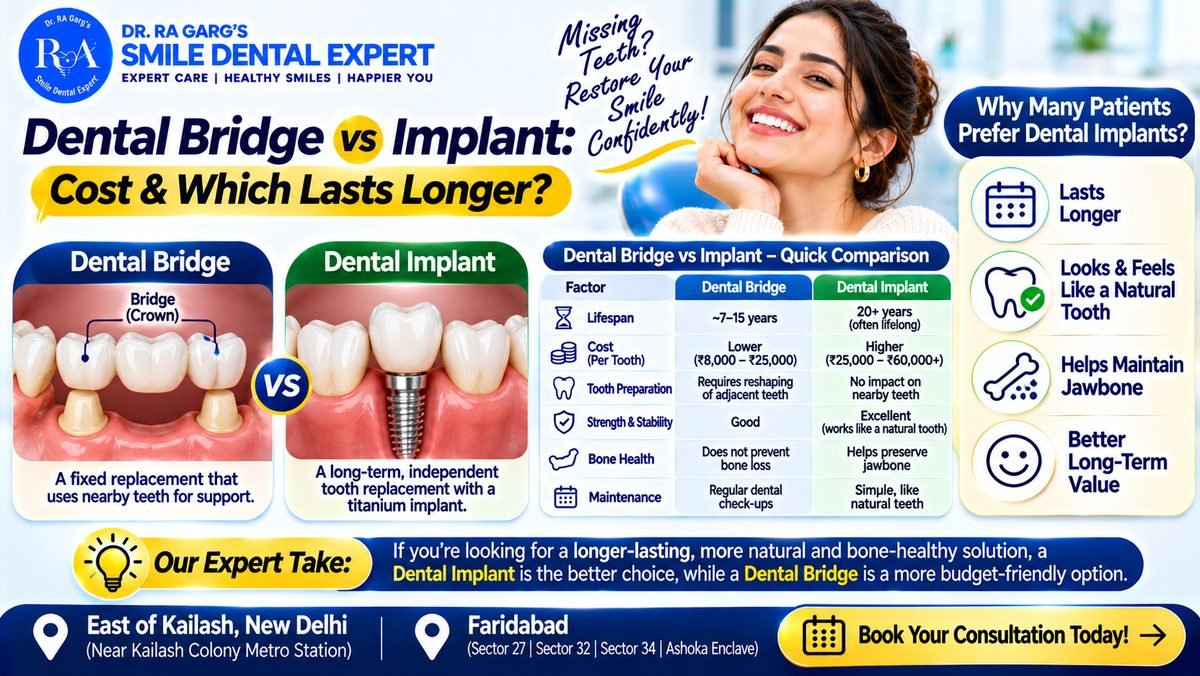
A bridge does exactly what its name suggests: it spans the gap. The two teeth on either side of the missing tooth are trimmed down and capped with crowns, and a false tooth (pontic) is fused between them — three connected units cemented as one piece. Your neighbouring teeth become the pillars that carry the replacement. A typical tooth bridge is fixed; you cannot (and should not) remove it.
How a dental implant works
An implant replaces the root, not just the crown. A titanium post is placed into the jawbone, bone fuses to it over 2–4 months (osseointegration), and a crown is then fixed on top. The result is a free-standing tooth that touches nothing beside it. The American Dental Association’s MouthHealthy resources describe implants as the closest modern dentistry comes to regrowing a natural tooth.
The one-line difference
A bridge borrows support from your remaining teeth. An implant builds its own support in bone. Almost every pro and con flows from that single difference.
Procedure & Timeline: What You Actually Go Through
Bridge: fast and surgery-free
- Visit 1: the two anchor teeth are shaped under local anaesthesia, impressions or digital scans are taken, and a temporary bridge is fitted.
- Visit 2 (about a week later): the final bridge is checked for fit and bite, then cemented.
Total time: roughly 7–10 days, no surgery, no stitches. This speed is the bridge’s genuine superpower.
Implant: slower, but no teeth are touched
- Planning: X-rays/CBCT scan to assess bone volume and plan position.
- Placement: a 30–60 minute minor surgical procedure under local anaesthesia. Most patients report it feels easier than an extraction.
- Healing: 2–4 months while bone locks onto the titanium surface.
- Crown fitting: an abutment and crown complete the tooth.
Total time: typically 3–5 months. In selected cases with good bone, immediate-loading protocols shorten this — our surgical lead, Dr. Ashish Garg (oral & maxillofacial surgeon), assesses eligibility case by case at both centres. Full procedure details are on our dental implant treatment in Faridabad and East of Kailash implant pages.
Cost Comparison in Delhi & Faridabad (₹, 2026)
| Option | Upfront Cost (₹) | Typical Lifespan | Teeth Trimmed? | Prevents Bone Loss? |
|---|---|---|---|---|
| 3-unit bridge, metal-ceramic (PFM) | ₹12,000 – ₹18,000 | 7–10 years | Yes (2 teeth) | No |
| 3-unit bridge, full zirconia | ₹24,000 – ₹45,000 | 10–15 years | Yes (2 teeth) | No |
| Single implant, Indian/Korean system + crown | ₹25,000 – ₹35,000 | 15–25+ years | No | Yes |
| Single implant, premium Swiss/German system + crown | ₹40,000 – ₹60,000 | 20–25+ years | No | Yes |
| Bone graft, if needed (add-on) | ₹8,000 – ₹20,000 | — | — | — |
Indicative Delhi-NCR ranges. A written, itemised quote follows your examination — for a deeper implant price breakdown see our dental implant cost in Delhi 2026 guide.
The Ten-Year Math: Why the Cheaper Option Flips
Here is the calculation most patients never see. Suppose you choose a ₹15,000 PFM bridge at age 40:
- Average bridge lifespan is 7–10 years, so by age 50 you are likely paying for a replacement bridge — at future prices.
- If decay creeps under an anchor crown (the most common failure), the anchor tooth may now need a root canal plus new crown: ₹8,000–₹15,000 extra.
- If an anchor tooth fails entirely, a 3-unit gap becomes a 4–5 unit problem — larger bridge or multiple implants.
Realistic 10–15 year outlay for the bridge path: ₹30,000–₹50,000+, plus the biological cost of two trimmed teeth. The implant path, at ₹30,000–₹45,000 once, usually ends there: a well-maintained implant typically does not need replacing within that window. The “expensive” option is frequently the cheaper one by year ten — which is why we insist patients compare journeys, not price tags.
Which Lasts Longer?
Implants win on longevity, and it is not close. Long-term studies consistently report implant survival rates above 90–95% at 10 years, and many implants serve for decades. Bridges average 7–10 years for PFM and 10–15 for zirconia — not because the bridge material fails, but because the anchor teeth underneath remain vulnerable to decay and fracture.
Why bridges usually fail
- Decay at the crown margins of anchor teeth (hidden under the bridge until advanced)
- Root canal problems in trimmed anchor teeth years later
- Fracture of an overloaded anchor tooth
Why implants fail (rarely)
- Peri-implantitis — gum infection around the implant, driven by poor hygiene or smoking
- Failure to integrate in the first months (uncommon, and usually re-attemptable)
An implant cannot decay — titanium gets no cavities — but it still needs clean, healthy gums. Daily hygiene and regular check-ups decide both options’ lifespans more than any brand name does.
Maintenance: the deciding habit
Whichever you choose, cleaning underneath is where lifespans are won. A bridge needs a floss threader or interdental brush passed under the pontic daily — skipping this is the quiet start of most bridge failures. An implant is simpler: brush and floss it like a natural tooth, and keep six-monthly professional cleanings so the gum collar around it stays tight and healthy. Patients who show up for recall visits routinely outlast every statistic quoted above.
What Each Option Does to Your Other Teeth & Jawbone
The cost to neighbouring teeth
To anchor a bridge, the dentist removes healthy enamel from two teeth that may never have had so much as a filling. That trimming is irreversible, and capped teeth carry a lifetime risk of needing root canals. An implant touches no other tooth — your neighbours stay exactly as nature made them.
The bone question nobody mentions
Jawbone stays dense only when it is stimulated by chewing forces through a root. Under the false tooth of a bridge, the bone receives no stimulation and slowly shrinks — which is why old bridges often develop a visible gap beneath the pontic. An implant transmits chewing force into the bone like a natural root, preserving it. The National Institute of Dental and Craniofacial Research has long documented this resorption pattern after tooth loss. If you may ever want an implant “later”, remember: the longer a gap sits under a bridge, the less bone remains to place one in.
When a Bridge Is the Better Choice
A bridge is not the villain of this story. We actively recommend one when:
- The neighbouring teeth already need crowns — if both anchors have large fillings or root canals, crowning them anyway makes the bridge nearly “free” in biological terms. Explore options on our dental crowns and bridges in Faridabad page.
- Medical conditions rule out minor surgery — uncontrolled diabetes, certain bone medications, or recent radiation therapy.
- Bone is too deficient and the patient declines grafting.
- Time is genuinely critical — a wedding in three weeks is a real constraint; a bridge delivers in one.
- Budget today is the hard limit — a bridge now beats an empty gap that drifts and tips the neighbouring teeth.
When an Implant Is the Better Choice
- The neighbouring teeth are healthy and untouched — grinding virgin teeth for a bridge is hard to justify in 2026.
- You are under 50–55 — the longer your remaining lifespan, the more replacement cycles a bridge will cost you.
- The gap is at the very back — with no tooth behind it, a conventional bridge is impossible; an implant is the only fixed option.
- Multiple adjacent teeth are missing — implants can carry their own bridge without touching natural teeth, the principle behind full mouth rehabilitation.
- You want the lowest-maintenance long game — one procedure, decades of service, normal brushing and flossing.
Frequently Asked Questions
Is a dental implant better than a bridge?
For most healthy patients with a single missing tooth and sound neighbouring teeth, yes — an implant lasts longer, protects the jawbone and spares adjacent teeth. A bridge is better when the anchor teeth already need crowns, surgery is medically unwise, or time/budget constraints are decisive.
How much does a tooth bridge cost in Faridabad and Delhi?
A three-unit metal-ceramic bridge typically costs ₹12,000–₹18,000; full zirconia runs ₹24,000–₹45,000 depending on material grade and lab work.
Which is more painful — bridge or implant?
Neither is painful during treatment thanks to local anaesthesia. Implant placement involves a day or two of mild soreness afterwards; bridge preparation can cause brief sensitivity in the trimmed teeth. Most implant patients tell us it was easier than they feared.
Can I convert my old bridge to implants later?
Often yes — but bone shrinks under a bridge over the years, so a graft may be needed. If implants are your eventual plan, earlier is biologically cheaper than later.
How long does a dental implant last compared to a bridge?
Implants show 90–95%+ survival at ten years and routinely last 20+ with good hygiene. Bridges average 7–15 years depending on material and, crucially, the health of the anchor teeth.
Does insurance or EMI cover these treatments?
Many Indian health policies still exclude routine dental work, but clinic-level EMI options can spread implant costs into monthly instalments. Ask us for the current payment plans during your consultation.
Our Clinic Locations
Smile Dental Care Centre — East of Kailash, New Delhi
C 8, Captain Gaur Marg, C Block Kailash Hills, East of Kailash, New Delhi 110065
Phone: 011 35966954 / +91 93183 39020
View on Google Maps
Smile Dental Care Centre — Faridabad
210, G Floor, Ashoka Enclave Main, Sector 34, Opp. Devsthal Mandir, Near Sarai Metro Station, Faridabad 121001
Phone: 0129 412 8720 / +91 99990 27270
View on Google Maps
Not sure which option your tooth qualifies for? Send your query on WhatsApp and we will guide you on the right assessment.
Get a Side-by-Side Quote for Your Own Tooth
Generic comparisons end where your X-ray begins. Bring your missing-tooth question to Dr. Ashish Garg at East of Kailash or Ashoka Enclave, Faridabad, and leave with both options costed side by side for your mouth — no pressure, just arithmetic. Call +91 93183 39020, message us on WhatsApp, or book an appointment online today.