
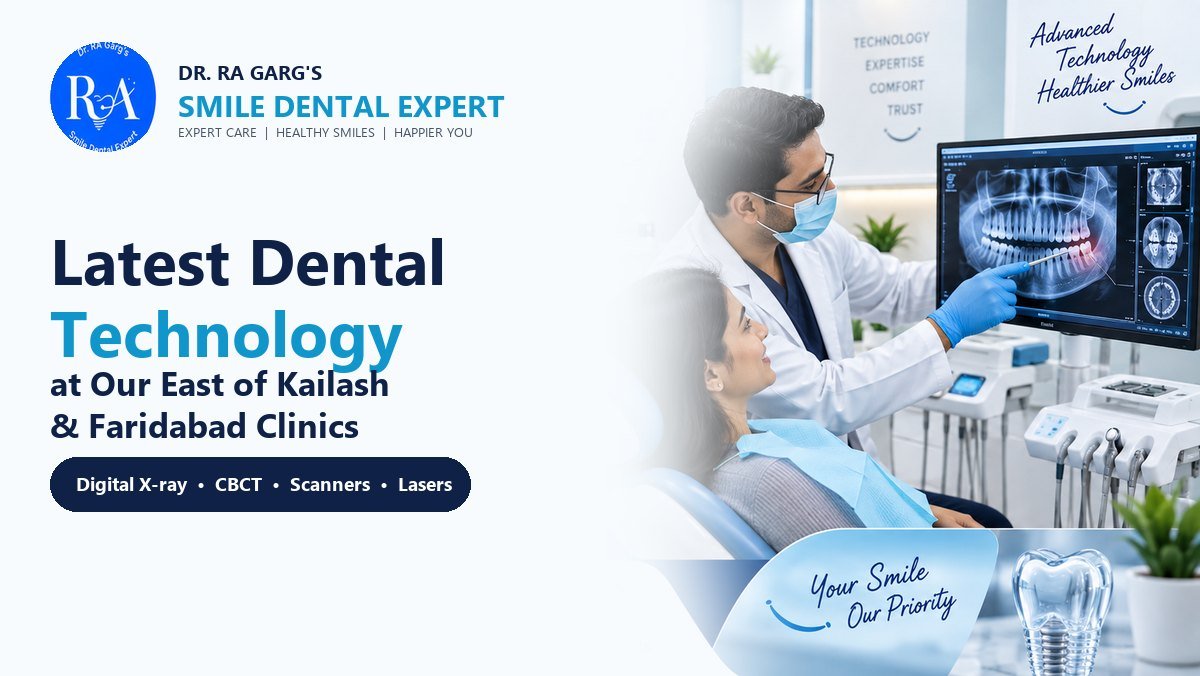
Walk into a state-of-the-art dental clinic in East of Kailash in 2026 and you will find very little resemblance to the dentistry of even ten years ago. Digital X-rays that cut radiation dramatically, intraoral cameras that let you see exactly what the dentist sees, 3D scans replacing gooey impressions, lasers replacing some drills — the latest dental technology has quietly transformed how safely, quickly and comfortably dental problems are fixed. In this guide, the team at Smile Dental Care Centre (Captain Gaur Marg, Kailash Hills, East of Kailash — serving Greater Kailash, Kailash Colony, Lajpat Nagar, Nehru Place and C.R. Park — and Ashoka Enclave, Sector 34, Faridabad) explains the key technologies modern patients should expect, what each one actually does for you, and the questions worth asking before you choose a clinic anywhere in South Delhi or the wider NCR.
Table of Contents
- Digital X-Rays at Our East of Kailash Clinic: Less Radiation, Instant Results
- Intraoral Cameras: See What Your Dentist Sees
- CBCT 3D Imaging: The Game-Changer for Implants & Surgery
- Intraoral Scanners: Goodbye, Gagging Impressions
- Rotary Endodontics & Apex Locators in Root Canals
- Dental Lasers: Where They Genuinely Help
- Sterilization Technology: The Upgrade Nobody Sees
- Teledentistry & Digital Patient Records
- A State-of-the-Art Dental Clinic in South Delhi: What It Means for You
- Frequently Asked Questions
- Our Clinic Locations
Digital X-Rays at Our East of Kailash Clinic: Less Radiation, Instant Results
Traditional film X-rays needed chemical developing, several minutes of waiting and a relatively higher radiation dose. Digital radiography (RVG — RadioVisioGraphy) replaces film with an electronic sensor: the image appears on a screen within seconds and can be enlarged, brightened and measured on the spot.
Why it matters to you
- Up to 80–90% less radiation than old film systems — significant for children, pregnant planning and patients needing multiple images.
- Instant diagnosis: no waiting between the X-ray and your treatment discussion.
- Earlier cavity detection: zoom and contrast tools reveal decay between teeth before it becomes a root canal problem.
- Easy records: images are stored digitally and can be shared with specialists or insurers in minutes.
Alongside small intraoral RVG sensors, a full-arch OPG (panoramic X-ray) maps all 32 teeth, both jaws and the sinuses in one sweep — essential before wisdom tooth surgery, braces and implant planning.
Intraoral Cameras: See What Your Dentist Sees
An intraoral camera is a pen-sized wand with a high-resolution lens that streams live images of your teeth onto a chairside screen. For the first time in dental history, patients do not have to take the dentist’s word for anything.
How intraoral camera dentistry changes your visit
- Transparency: you see the cracked filling, the plaque line or the early cavity yourself, magnified many times, before agreeing to any treatment.
- Better decisions: comparing before-and-after images shows you precisely what was done.
- Catching the invisible: hairline fractures and early enamel breakdown that are hard to spot with the naked eye show up clearly on camera.
We use intraoral cameras at both our clinics as a standard part of consultations — patients from Kailash Hills to NIT Faridabad consistently tell us that seeing the problem on screen removed their doubt about whether treatment was really needed.
CBCT 3D Imaging: The Game-Changer for Implants & Surgery
Cone Beam Computed Tomography (CBCT) creates a three-dimensional model of your jaws, showing bone height, width and density plus the exact position of nerves and sinuses — details a flat X-ray simply cannot convey.
Where CBCT makes the difference
- Dental implants: the surgeon measures available bone to the millimetre and selects implant size and angle before surgery, making placement faster and safer. This is central to how modern dental implant treatment in East of Kailash achieves its high success rates — the same CBCT-guided planning we use at our Faridabad branch.
- Difficult wisdom teeth: when roots sit near the nerve canal, 3D imaging shows the exact relationship, protecting you from numbness complications.
- Complex root canals: extra canals and unusual root curvatures are mapped before treatment begins.
Research resources at the National Institute of Dental and Craniofacial Research underline how imaging-guided planning has improved surgical predictability over the last decade — a benefit now available routinely in Indian clinics, not just research hospitals.
Intraoral Scanners: Goodbye, Gagging Impressions
If you have ever gagged on a tray of impression putty, you will appreciate this upgrade most of all. An intraoral scanner is a slim wand that films your teeth and builds a precise 3D digital model in minutes — no trays, no putty, no gagging.
What digital impressions are used for
- Crowns and bridges: the scan goes digitally to the lab, improving fit and cutting delivery time.
- Clear aligners: digital models drive the movement simulation you approve before starting Invisalign aligner treatment in East of Kailash.
- Smile previews: for cosmetic cases, your planned result can be visualised before any tooth is touched — the digital workflow behind modern smile designing in East of Kailash.
Rotary Endodontics & Apex Locators in Root Canals
Root canal treatment has benefited from technology more than almost any other procedure. Two tools transformed it:
Rotary endodontics
Flexible nickel-titanium instruments driven by a precision motor clean and shape canals far faster and more uniformly than hand filing. Faster instrumentation means shorter appointments — often a single sitting — and less post-operative soreness.
Electronic apex locators
These devices measure the exact length of each root canal electronically, so the dentist cleans and fills precisely to the root tip — not short (risking reinfection) and not beyond (risking pain). Combined with digital X-ray verification, they are a core reason modern painless root canal treatment in Delhi and Faridabad lives up to its name.
Dental Lasers: Where They Genuinely Help
Lasers are not marketing gimmicks when used for the right indications. Soft-tissue diode lasers seal as they work, which means minimal bleeding, often no sutures and faster healing. Genuine laser strengths include:
- Reshaping gums around new crowns and veneers for a clean margin
- Treating gum pockets and disinfecting during periodontal therapy
- Correcting gummy smiles and removing small growths with minimal discomfort
- Reducing bacteria inside root canals as an adjunct to cleaning
Ask your clinic which specific procedures they use the laser for — a thoughtful answer signals genuine expertise rather than a showroom purchase.
Sterilization Technology: The Upgrade Nobody Sees
The most important technology in any dental clinic is the one patients rarely ask about. Modern infection control means Class B autoclaves that sterilise instruments with vacuum-assisted steam cycles, sealed and dated instrument pouches opened in front of you, single-use disposables for needles and suction tips, and distilled-water lines in dental chairs. The World Health Organization’s oral health guidance emphasises safe, quality-assured care as a cornerstone of oral health services — and sterilization discipline is exactly where that begins. You can read more about the equipment and protocols at our clinics on our facilities page.
Teledentistry & Digital Patient Records
Technology has also changed what happens before and between visits. Patients now send a photo of a swelling or a broken tooth on WhatsApp and receive preliminary guidance the same day — whether it can wait for a routine slot or needs to be seen immediately. Digital patient records mean your X-rays, prescriptions and treatment history from two years ago are retrievable in seconds, so a new problem is always judged against your full dental timeline rather than memory.
Why digital records protect you
- Continuity: if you move between our East of Kailash and Faridabad clinics, your complete file follows you digitally.
- Insurance and reimbursement: dated digital X-rays and treatment notes make claim documentation straightforward.
- Second opinions: your images can be shared with any specialist you choose — your records belong to you.
Teledentistry does not replace examination — an online photo cannot detect decay between teeth or measure gum pockets — but it is excellent triage, saving unnecessary trips and catching genuine emergencies early.
A State-of-the-Art Dental Clinic in South Delhi: What It Means for You
Technology is not about gadgets; it changes outcomes you can feel:
- Fewer visits: digital workflows compress crowns, root canals and consultations into fewer appointments — valuable if you commute from Nehru Place or Greater Kailash offices in South Delhi, or from Sector 27 and Sector 32 in Faridabad.
- Earlier, cheaper treatment: problems caught on digital imaging at the filling stage cost a fraction of the root canal or extraction they would otherwise become.
- Less pain, faster healing: precision instruments remove less healthy tissue, and lasers reduce bleeding and swelling.
- Informed consent, genuinely: when you can see the problem on a screen, you are a participant in the decision, not a bystander.
Questions to ask any clinic before you book
- Do you use digital X-rays (RVG), and is an OPG available in-house?
- Will I see my problem on an intraoral camera before treatment is proposed?
- Is implant planning done on CBCT 3D imaging?
- What autoclave class do you use, and are instruments pouch-sealed?
- Which procedures do you actually use the laser for?
Any quality clinic will answer these happily. You can learn about our doctors’ qualifications and approach on our about page.
Frequently Asked Questions
Are digital dental X-rays safe?
Yes. Digital sensors need far less radiation than old film X-rays — a routine RVG image delivers a dose comparable to a short flight’s natural background exposure. Lead aprons and thyroid collars reduce exposure further.
Does a state-of-the-art dental clinic in East of Kailash cost more?
Consultation and treatment fees at well-equipped independent clinics are usually comparable to ordinary clinics, because technology saves chair time. The real saving is fewer repeat treatments caused by diagnostic guesswork.
What is the difference between an OPG and a CBCT scan?
An OPG is a flat panoramic X-ray of both jaws, ideal for general assessment. CBCT is a 3D scan showing bone in all dimensions — needed for implant planning, complex extractions and some root canal cases.
Can I ask to see my intraoral camera images and X-rays?
Absolutely — and you should. At Smile Dental Care Centre we show every patient their images on the chairside screen and share digital copies on request or on WhatsApp.
Is laser dentistry better than conventional treatment for everything?
No. Lasers excel in soft-tissue procedures and as adjuncts to gum and root canal therapy, but conventional instruments remain the standard for many restorative tasks. A good clinic uses each tool where evidence supports it.
Do both your East of Kailash and Faridabad clinics have the same technology?
Yes. Both our East of Kailash (Kailash Hills) and Ashoka Enclave clinics run digital X-rays, intraoral cameras, rotary endodontics and modern sterilization, so patients from Greater Kailash, Lajpat Nagar, C.R. Park or Faridabad receive the same standard of care at either location.
Our Clinic Locations
Smile Dental Care Centre — East of Kailash, New Delhi
C 8, Captain Gaur Marg, C Block Kailash Hills, East of Kailash, New Delhi 110065
Phone: 011 35966954 / +91 9318339020
View on Google Maps — East of Kailash
Smile Dental Care Centre — Ashoka Enclave, Faridabad
210, G Floor, Ashoka Enclave Main, Sector 34, Opp. Devsthal Mandir, Near Sarai Metro Station, Faridabad 121001
Phone: 0129 412 8720 / +91 99990 27270
View on Google Maps — Faridabad
Want to know which technology your treatment needs? Ask us on WhatsApp — we reply quickly.
Experience Modern Dentistry for Yourself
Choosing a clinic equipped with today’s technology means safer diagnosis, gentler treatment and fewer visits. Book a consultation at Smile Dental Care Centre in East of Kailash or Faridabad and see the difference on screen. Call +91 93183 39020, WhatsApp us, or book your appointment online today.