

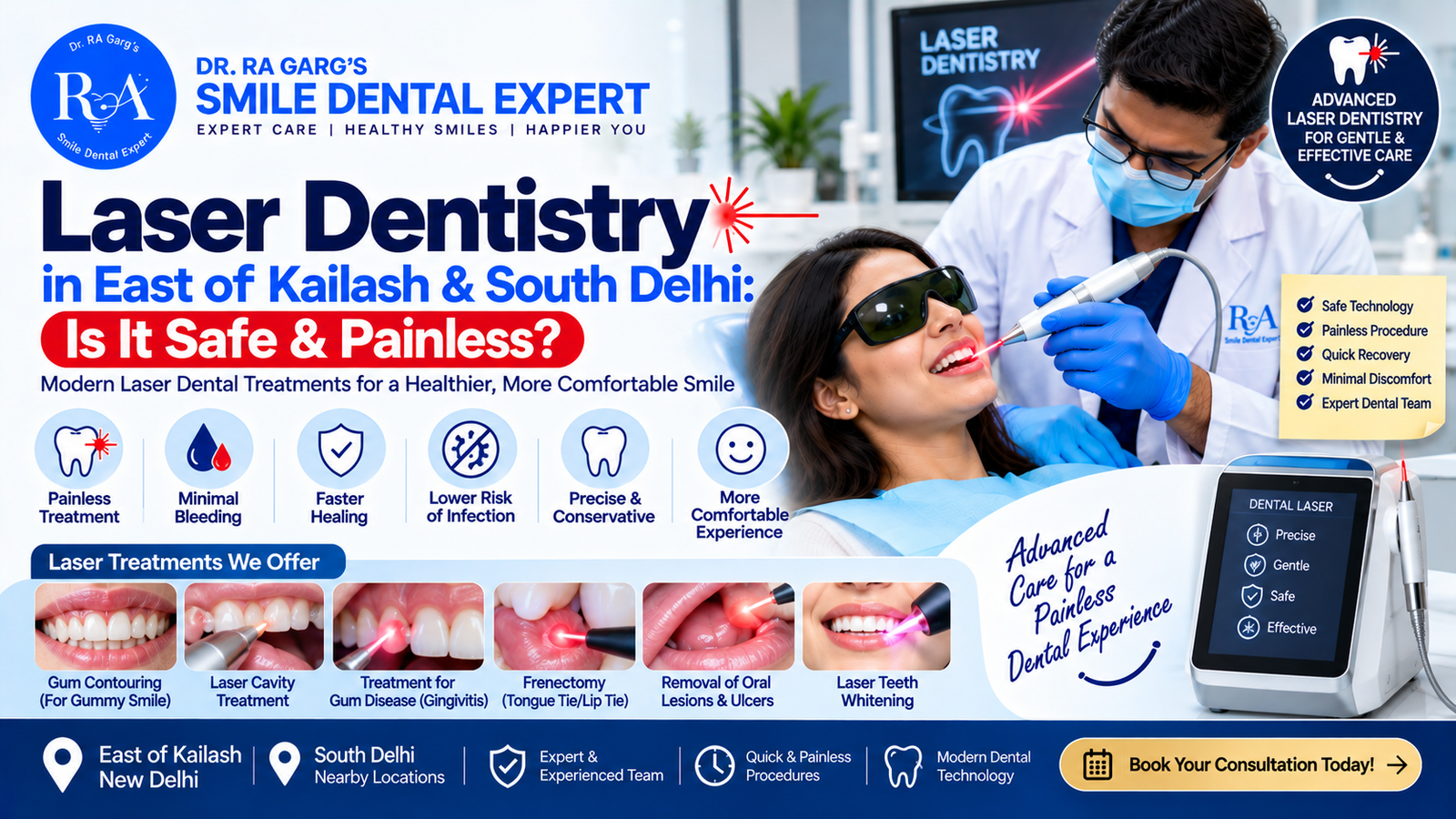
Is laser dentistry safe and painless? Short answer: yes —Laser dentistry in East of Kailash offers a modern approach to selected dental procedures, including gum treatment, certain cavity treatments and soft-tissue procedures. At Smile Dental Care Centre, East of Kailash, New Delhi, our dental team evaluates whether laser-assisted treatment is suitable for your dental needs. Patients looking for comfortable dental care can discuss the benefits, limitations and expected costs of laser dentistry before starting treatment. We also serve patients at our Faridabad clinic in Sector 34, Ashoka Enclave.
Table of Contents
- What Exactly Is Laser Dentistry?
- How Dental Lasers Work on Teeth and Gums
- Is Laser Dentistry Safe? What the Evidence Says
- Painless Dental Treatment in South Delhi: Honest Expectations
- 8 Dental Treatments Done Better with Lasers at Our East of Kailash Clinic
- Laser vs Conventional Dentistry: Side-by-Side Comparison
- Limitations and Side Effects You Should Know
- Laser Dental Treatment Costs in South Delhi & Delhi NCR
- FAQs
- Our Clinic Locations
What Exactly Is Laser Dentistry?
A dental laser is a device that delivers a precisely focused beam of light energy at a specific wavelength. Different wavelengths interact with different tissues: some are absorbed by water and minerals in tooth structure, others by the pigment and water in gum tissue. That selectivity is the magic — a soft-tissue laser can reshape the gum line without touching the tooth, and a hard-tissue laser can remove decay while sparing healthy enamel.
Lasers have been used in dentistry since the 1990s and are now standard equipment in advanced practices worldwide. The two broad families you will hear about are:
Soft-tissue lasers (diode lasers)
Used for gum disease therapy, reshaping gums, removing small growths, treating ulcers, and disinfecting root canals. They cut and sterilise at the same time, sealing tiny blood vessels as they work — which is why many gum procedures finish with little or no bleeding.
Hard-tissue lasers (erbium family)
Used on enamel and dentine for removing early decay and preparing cavities, frequently with reduced or no drilling and sometimes without anaesthesia at all.
How Dental Lasers Work on Teeth and Gums
The laser delivers energy in extremely short pulses. On gum tissue, that energy vaporises a micro-thin layer of diseased tissue and bacteria while coagulating blood vessels beneath — a self-sealing incision. On tooth structure, the energy excites water molecules inside the decayed portion, which breaks down the softened, infected area while healthy tissue — with less water content — stays largely unaffected.
Three practical consequences follow. First, there is no rotating bur generating heat, pressure, and vibration — the sensations your brain reads as “dental pain”. Second, the laser leaves the treated surface decontaminated, reducing bacterial counts in gum pockets and canals. Third, because trauma to surrounding tissue is minimal, healing is noticeably faster than with a scalpel or drill.
Is Laser Dentistry Safe? What the Evidence Says
Dental lasers used by trained clinicians have an excellent safety record built over three decades. The American Dental Association’s patient resources recognise lasers as an adjunct for several procedures, and bodies like the NIH’s National Institute of Dental and Craniofacial Research continue to fund research into laser applications in caries removal and periodontal care.
Safety in practice rests on three pillars:
- Correct wavelength and settings for the tissue — a trained operator matches energy levels to the task, exactly as a surgeon chooses the right instrument.
- Protective eyewear — both you and the clinical team wear wavelength-specific glasses during treatment; this is routine, not a warning sign.
- Operator training — Indian clinics offering laser dentistry should have certified training on their specific laser system, something you are entitled to ask about.
Used correctly, a laser is arguably gentler than the instruments it replaces: no accidental slips of a blade, no over-cutting, and a sterile field as it works. Pregnant patients, diabetics, and cardiac patients can generally receive laser dental care safely — in fact, the reduced bleeding and lower infection risk often make lasers the preferred choice for medically complex patients. Patients with pacemakers should inform the dentist beforehand, as with any dental equipment.
Painless Dental Treatment in South Delhi: Honest Expectations
“Painless” is the most-used word in dental marketing across South Delhi, so let us be precise about what laser treatment actually feels like at our East of Kailash and Faridabad clinics:
- Soft-tissue procedures (gum contouring, pocket disinfection, ulcer treatment): most patients feel mild warmth or a tingling sensation. Many procedures need only numbing gel rather than an injection.
- Hard-tissue procedures (early cavity removal): the laser’s micro-pulses typically do not trigger the nerve the way a drill’s heat and vibration do. Many small cavities are treated with no anaesthesia; deeper ones may still need an injection.
- After the procedure: because there is less tissue trauma, post-operative soreness is usually milder and shorter than after conventional surgery — most gum laser patients return to normal eating the same day.
So, is it 100% sensation-free for every patient, every time? No honest dentist will promise that. Is it dramatically more comfortable than the drill-and-scalpel experience most Indians grew up with? Overwhelmingly, yes — it is a core part of the comfort-first philosophy behind our painless root canal treatment in Delhi and Faridabad.
8 Dental Treatments Done Better with Lasers at Our East of Kailash Clinic
1. Gum disease (periodontal) therapy
The laser tip slides into infected gum pockets, vaporising bacteria and diseased lining that scaling instruments cannot fully reach. Combined with conventional deep cleaning, it improves pocket healing with far less discomfort for patients visiting us from Greater Kailash, Lajpat Nagar and C.R. Park — and it is equally a cornerstone of our gum disease treatment in Faridabad.
2. Gum reshaping and smile corrections
Uneven gum lines that make teeth look short can be sculpted in minutes with instant sealing — a frequent step in smile designing at our East of Kailash clinic.
3. Laser-assisted teeth whitening
Laser energy activates the whitening gel for faster, deeper stain removal in a single visit — part of our cosmetic dental treatments in East of Kailash, with detailed pricing on our teeth whitening cost page.
4. Early cavity treatment
Small and moderate cavities can be cleaned with minimal drilling, preserving more natural tooth before placing a bonded filling.
5. Root canal disinfection
Laser energy reaches side branches of root canals that files and liquids miss, lowering the bacterial load before sealing.
6. Ulcers and cold sores
A few seconds of low-level laser dramatically reduces ulcer pain and speeds healing — a lifesaver for recurrent mouth ulcer sufferers.
7. Frenectomy and tongue-tie release
Children with tongue-tie or a tight lip frenum are treated in minutes, with little bleeding and usually no stitches.
8. Removal of small growths and biopsies
Fibromas and small overgrowths are removed cleanly with immediate haemostasis, and the specimen can still be sent for histopathology.
Laser vs Conventional Dentistry: Side-by-Side Comparison
| Aspect | Laser Dentistry | Conventional (Drill/Scalpel) |
|---|---|---|
| Pain during procedure | Minimal; often gel-only anaesthesia | Needs injections; vibration and pressure felt |
| Bleeding | Very little; laser seals as it cuts | Normal surgical bleeding; may need sutures |
| Healing time (soft tissue) | Fast — often 2–4 days | Typically 7–14 days |
| Infection risk | Lower; laser sterilises the field | Standard; relies on medication |
| Precision | Micro-level, tissue-selective | Depends on instrument and operator |
| Noise and vibration | Near silent | Drill noise; a major anxiety trigger |
| Suitability | Soft tissue, early decay, disinfection | All cases, incl. deep crowns and complex surgery |
| Cost | ₹500 – ₹3,000 extra per procedure | Base pricing |
Limitations and Side Effects You Should Know
Honesty builds trust, so here is what lasers cannot do. They cannot remove old metal or large ceramic fillings, prepare teeth for full crowns on their own, or replace surgery for deeply impacted wisdom teeth — a drill or surgical handpiece still does some jobs best. Very deep cavities close to the nerve may still need conventional instrumentation and anaesthesia. Side effects are uncommon and mild: temporary soreness, slight swelling, or a day of sensitivity. Choosing an experienced clinic — you can see our complete equipment list on the facilities page — keeps even these to a minimum.
Laser Dental Treatment Costs in South Delhi & Delhi NCR
Laser procedures in South Delhi typically add a modest premium over conventional techniques: laser gum pocket disinfection runs about ₹1,000–₹2,500 per quadrant, gum reshaping ₹2,000–₹6,000 depending on the number of teeth, laser ulcer therapy ₹500–₹1,000 per sitting, and laser-assisted whitening ₹8,000–₹15,000 for both arches. Prices at our East of Kailash and Faridabad branches are identical, so you can choose whichever clinic is closer — Kailash Hills or Ashoka Enclave. Most patients find the faster healing, fewer follow-up visits, and reduced medication worth the difference. We always quote laser and conventional options side by side so you choose with full information — see our dental clinic in South Delhi page for everything we offer under one roof.
Frequently Asked Questions
Is laser dentistry safe for children?
Yes. Lasers are especially child-friendly: no frightening drill noise, often no injection, minimal bleeding, and quick healing. Tongue-tie release and small cavity treatment in kids are two of the most common laser procedures at our clinics.
Does laser treatment damage teeth or gums?
Not when used at correct settings by a trained dentist. The wavelengths used are tissue-selective and non-ionising — dental lasers do not carry radiation risk like X-rays, and they do not weaken enamel.
Is laser gum treatment better than normal cleaning?
It is an upgrade, not a replacement. Scaling still removes hardened tartar; the laser then disinfects the pocket lining and stimulates healing. For moderate to severe gum disease, the combination gives better comfort and results than scaling alone.
Will I need anaesthesia for laser dental work?
Often just a numbing gel for soft-tissue work and small cavities. Deeper procedures may still need a local injection — but patients consistently report the overall experience as far gentler than conventional treatment.
How much does laser dentistry cost in East of Kailash, South Delhi?
Expect roughly ₹500–₹3,000 above conventional pricing per procedure at our East of Kailash clinic: gum laser therapy from ₹1,000 per quadrant, gum reshaping from ₹2,000, laser whitening ₹8,000–₹15,000. Faridabad pricing is the same, and we provide exact written quotes after examination.
Which clinic offers laser dentistry near Greater Kailash, Lajpat Nagar and Nehru Place?
Smile Dental Care Centre on Captain Gaur Marg, Kailash Hills, East of Kailash is a short drive from Greater Kailash, Kailash Colony, Lajpat Nagar, Nehru Place and C.R. Park. We offer laser-assisted gum therapy, cavity treatment, whitening, and soft-tissue procedures there and at our Ashoka Enclave, Sector 34, Faridabad branch near Sarai Metro Station.
Our Clinic Locations
Smile Dental Care Centre — East of Kailash, New Delhi
C 8, Captain Gaur Marg, C Block Kailash Hills, East of Kailash, New Delhi 110065
Phone: 011 35966954 / +91 9318339020
Get directions on Google Maps (East of Kailash)
Smile Dental Care Centre — Ashoka Enclave, Faridabad
210, G Floor, Ashoka Enclave Main, Sector 34, Opp. Devsthal Mandir, Near Sarai Metro Station, Faridabad 121001
Phone: 0129 412 8720 / +91 99990 27270
Get directions on Google Maps (Faridabad)
Curious whether your treatment can be done with laser? Ask us on WhatsApp +91 93183 39020.
Experience Dentistry Without the Drill
If dental fear has been postponing your treatment, laser dentistry is the gentlest way back. Call +91 93183 39020, message us on WhatsApp, or book an appointment online at Smile Dental Care Centre — East of Kailash or Faridabad — and discover how comfortable modern dental care can be.
