
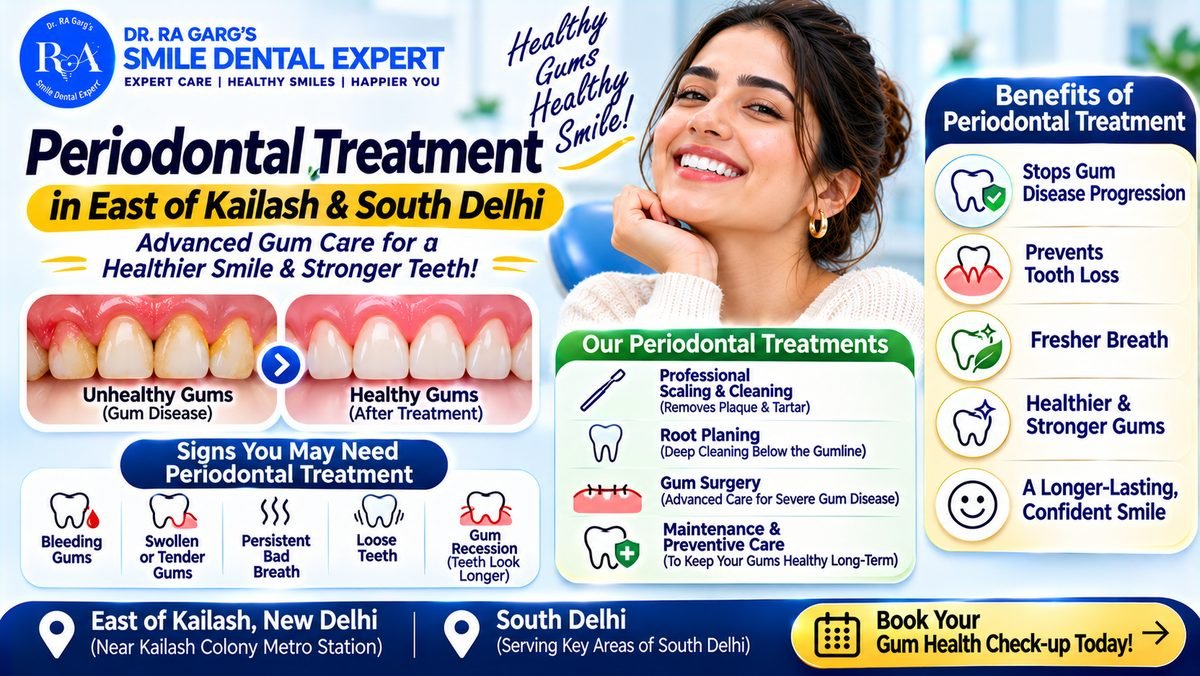
When a dentist says you need periodontal treatment, most patients hear only one frightening word: surgery. In reality, periodontal (gum) therapy is a ladder with many rungs — and the vast majority of patients at our East of Kailash (South Delhi) clinic on Captain Gaur Marg, Kailash Hills — and at our Faridabad branch — are treated on the lower rungs, with deep cleaning and medication, never needing a scalpel at all. Patients come to us from across South Delhi: Greater Kailash, Kailash Colony, Lajpat Nagar, Nehru Place and C.R. Park. The key is understanding where you stand on that ladder and acting before the disease climbs further. This guide walks you through every stage of modern gum treatment — from scaling and root planing to flap surgery, bone grafting and laser-assisted therapy — with realistic Indian costs, recovery timelines and the honest criteria dentists use to decide which rung you are on.
Table of Contents
- What Is Periodontal Treatment?
- The Four Stages of Gum Disease
- Non-Surgical Therapy: Scaling & Root Planing
- Medication & Local Antibiotic Therapy
- When Gum Surgery Becomes Necessary
- Periodontal Treatment Costs in East of Kailash & South Delhi (₹)
- Recovery & Periodontal Maintenance at Our East of Kailash Centre
- Frequently Asked Questions
- Our Clinic Locations
What Is Periodontal Treatment?
“Periodontium” means everything that holds a tooth in place — the gums, the periodontal ligament and the jawbone. Periodontal treatment is any therapy that stops infection in these supporting structures and, where possible, rebuilds what has been lost. According to the National Institute of Dental and Craniofacial Research (NIDCR), periodontal disease is one of the leading causes of tooth loss in adults — not cavities, as most people assume.
What makes gum disease dangerous is its silence. Teeth can look perfectly white while the bone beneath them quietly dissolves. By the time teeth feel loose, 40–60% of supporting bone may already be gone. That is why a proper gum treatment plan always begins with measurement, not guesswork: a periodontal probe records pocket depths around every tooth, and digital X-rays map the bone levels.
Signs you may need periodontal therapy
- Gums that bleed during brushing or eating
- Persistent bad breath despite good brushing
- Gums pulling away from teeth, making teeth look longer
- Pus between teeth and gums, or a bad taste
- Teeth drifting, developing gaps or feeling slightly mobile
The Four Stages of Gum Disease
Stage 1: Gingivitis
Inflammation limited to the gum margin — red, puffy, bleeding gums with no bone loss yet. Fully reversible with professional cleaning and improved home care. This is the only stage at which gum disease can be completely cured rather than controlled.
Stage 2: Early periodontitis
Pockets of 4–5 mm form between tooth and gum, and the first millimetres of bone are lost. Treated non-surgically with deep cleaning in almost all cases.
Stage 3: Moderate periodontitis
Pockets reach 5–7 mm, bone loss becomes visible on X-rays, and some teeth may show early mobility. Deep cleaning is still the first line, but some sites may need surgical access.
Stage 4: Advanced periodontitis
Pockets beyond 7 mm, significant bone destruction, loose or drifting teeth, sometimes abscesses. Surgery, regenerative procedures or extraction with replacement — such as dental implant treatment in East of Kailash — enter the conversation at this stage.
Non-Surgical Therapy: Scaling & Root Planing
Scaling and root planing (SRP) — what patients call “deep cleaning” — is the workhorse of periodontal treatment and resolves the majority of early and moderate cases.
How deep cleaning differs from regular cleaning
A routine cleaning polishes the visible crown of the tooth above the gumline. SRP goes further: ultrasonic scalers and fine hand instruments clean below the gumline, removing hardened tartar from the root surface, then smoothing (planing) the root so the gum can reattach snugly. Smooth roots give bacteria nowhere to grip.
What the procedure feels like
SRP is done under local anaesthesia, usually one half or one quadrant of the mouth per visit, with each session lasting 45–60 minutes. Patients are consistently surprised by how comfortable it is — mild gum tenderness for a day or two and brief cold sensitivity are the typical after-effects, managed with a desensitising toothpaste.
How well does it work?
Re-evaluation happens 4–6 weeks later. In our experience across both clinics, most pockets of 4–6 mm shrink to maintainable levels after thorough SRP combined with corrected brushing technique. Only the sites that fail to respond are shortlisted for surgery — never the whole mouth by default. You can read more about our complete approach at our dental clinic in South Delhi, or on the gum disease treatment in Faridabad page.
Medication & Local Antibiotic Therapy
Medication supports mechanical cleaning; it never replaces it. Depending on your case, your dentist may add:
- Chlorhexidine mouth rinse for 1–2 weeks after deep cleaning to suppress bacterial regrowth
- Local antibiotic gels or chips placed directly into stubborn deep pockets, releasing medicine for days
- Systemic antibiotics in aggressive or abscessed cases, always for a defined short course
- Management of underlying conditions — uncontrolled diabetes dramatically worsens gum disease, so we coordinate with your physician where needed
Patients who smoke are counselled frankly: smoking narrows gum blood vessels, masks bleeding (hiding the warning sign) and roughly doubles the failure rate of every periodontal procedure. The WHO oral health fact sheet lists tobacco use among the leading risk factors for severe periodontal disease worldwide.
When Gum Surgery Becomes Necessary
Surgery is reserved for sites where pockets stay 6 mm or deeper after SRP, or where bone defects need rebuilding. Modern gum surgery is precise, conservative and far gentler than its reputation.
Flap surgery (open flap debridement)
The gum is gently lifted like a page of a book, giving direct vision of the root and bone. Deep deposits are removed, infected tissue is cleaned out, and the gum is stitched back at a healthier level. Done under local anaesthesia, usually one quadrant at a time, in 60–90 minutes.
Bone grafting and regeneration
Where the disease has carved craters into the bone, graft material and regenerative membranes can encourage new bone fill. Regenerating support can save teeth that would otherwise be lost — and preserves bone volume in case an implant is ever needed later.
Laser-assisted periodontal therapy
A dental laser can disinfect pockets and remove diseased pocket lining with minimal bleeding and faster soft-tissue healing. We use laser assistance in selected cases at both centres; you can see the equipment on our facilities page.
Gingivectomy and crown lengthening
Where gum overgrowth (from medication or chronic inflammation) creates false pockets, reshaping the gum margin restores a cleanable contour.
All surgical periodontal procedures at Smile Dental Care Centre are planned with our surgical team led by Dr. Ashish Garg, oral and maxillofacial surgeon, which matters for advanced cases where bone regeneration, extractions and full mouth rehabilitation must be coordinated in one plan.
Periodontal Treatment Costs in East of Kailash & South Delhi (₹)
Costs scale with the severity of disease — one more reason early treatment is the economical choice. These ranges hold across South Delhi (East of Kailash, Greater Kailash, Lajpat Nagar) and at our Faridabad branch.
| Procedure | Typical Cost Range (₹) | Visits |
|---|---|---|
| Full-mouth scaling & polishing | ₹1,000 – ₹2,500 | 1 |
| Scaling & root planing (per quadrant) | ₹1,500 – ₹3,500 | 2–4 total |
| Local antibiotic gel placement (per site) | ₹500 – ₹1,500 | 1 |
| Laser pocket disinfection (per quadrant) | ₹2,500 – ₹5,000 | 1–2 |
| Flap surgery (per quadrant) | ₹5,000 – ₹12,000 | 1 + review |
| Bone graft / regenerative material (per site) | ₹8,000 – ₹20,000 | 1 + reviews |
| Periodontal maintenance recall | ₹800 – ₹2,000 | Every 3–6 months |
Indicative 2026 ranges for Delhi-NCR. Your written estimate follows the periodontal charting at your first visit, so you know the full cost before anything begins.
Recovery & Periodontal Maintenance at Our East of Kailash Centre
After deep cleaning
Expect mild tenderness for 24–48 hours and temporary cold sensitivity as roots are freshly cleaned. Normal eating usually resumes the same day; warm salt-water rinses help.
After flap surgery
Swelling and tenderness peak around day two and settle within a week; stitches come out at 7–10 days. Soft foods for a few days and meticulous (but gentle) cleaning of the area are the two rules that matter.
Your home-care toolkit after gum treatment
Successful periodontal therapy is 50% clinic work and 50% what happens at your sink. After active treatment we equip every patient with a specific kit: a soft or ultra-soft brush used with the modified Bass technique (bristles angled into the gumline), interdental brushes sized to each gap rather than one-size-fits-all, and — for wider spaces after bone loss — a water flosser as a supplement. Patients in Kailash Hills, Greater Kailash, C.R. Park and Ashoka Enclave get a hands-on demonstration at the chair, because technique taught on a model rarely survives contact with a real bathroom mirror.
Why maintenance is non-negotiable
Periodontitis is controlled, not cured. Bacteria repopulate pockets within weeks, so patients who complete active therapy enter a periodontal maintenance programme — professional cleaning and pocket checks every three to six months. Patients who keep these recalls keep their teeth; those who vanish for two years usually return to find the disease has resumed exactly where it left off. Pair the recalls with twice-daily brushing, daily interdental cleaning and tobacco cessation, and the long-term outlook is excellent.
Frequently Asked Questions
Is periodontal treatment painful?
No. Deep cleaning and gum surgery are both done under local anaesthesia, so you feel pressure and vibration but not pain. Post-treatment soreness is mild and controlled with ordinary painkillers for a day or two.
Can gum disease be cured without surgery in East of Kailash?
Gingivitis can be fully reversed, and most early-to-moderate periodontitis is controlled with scaling and root planing alone. Surgery is needed only for the specific sites that fail to respond — typically a minority of cases we see at our East of Kailash (South Delhi) and Faridabad clinics.
How many sittings does deep cleaning take at a South Delhi gum clinic?
Usually two to four visits, treating one side or one quadrant of the mouth per sitting, followed by a re-evaluation after four to six weeks.
Will my teeth become loose after deep cleaning?
No — deep cleaning removes tartar, not tooth support. Some teeth may briefly feel different because inflamed, swollen gums are tightening, but SRP does not loosen teeth. Loss of support is caused by the disease itself.
How long does periodontal treatment take to show results?
Bleeding typically reduces within two weeks of deep cleaning. Pocket shrinkage and gum reattachment are measured at the 4–6 week review, and bone regeneration (where grafting is done) matures over several months.
What happens if advanced gum disease is left untreated?
Pockets deepen, abscesses develop, teeth loosen and are eventually lost. Research also links untreated periodontitis to poorer control of diabetes and cardiovascular risks — gum health is genuinely whole-body health.
Our Clinic Locations
Smile Dental Care Centre — East of Kailash, New Delhi
C 8, Captain Gaur Marg, C Block Kailash Hills, East of Kailash, New Delhi 110065
Phone: 011 35966954 / +91 93183 39020
View on Google Maps
Smile Dental Care Centre — Faridabad
210, G Floor, Ashoka Enclave Main, Sector 34, Opp. Devsthal Mandir, Near Sarai Metro Station, Faridabad 121001
Phone: 0129 412 8720 / +91 99990 27270
View on Google Maps
Questions about your gums? Message us on WhatsApp for guidance on which assessment you need.
Bleeding Gums Are a Message — Answer Early
Every rung you climb on the periodontal ladder costs more time, money and bone than the one below it. If your gums bleed, your breath has changed, or a tooth feels even slightly mobile, book a periodontal charting this month — not after Diwali, not “when it hurts”. Call +91 93183 39020, say hello on WhatsApp, or book an appointment online at our East of Kailash or Faridabad gum disease treatment centre.